The Complete Guide to Ultrasonic Cleaners
Listen to a podcast about this article
The Complete Guide to Ultrasonic Cleaners
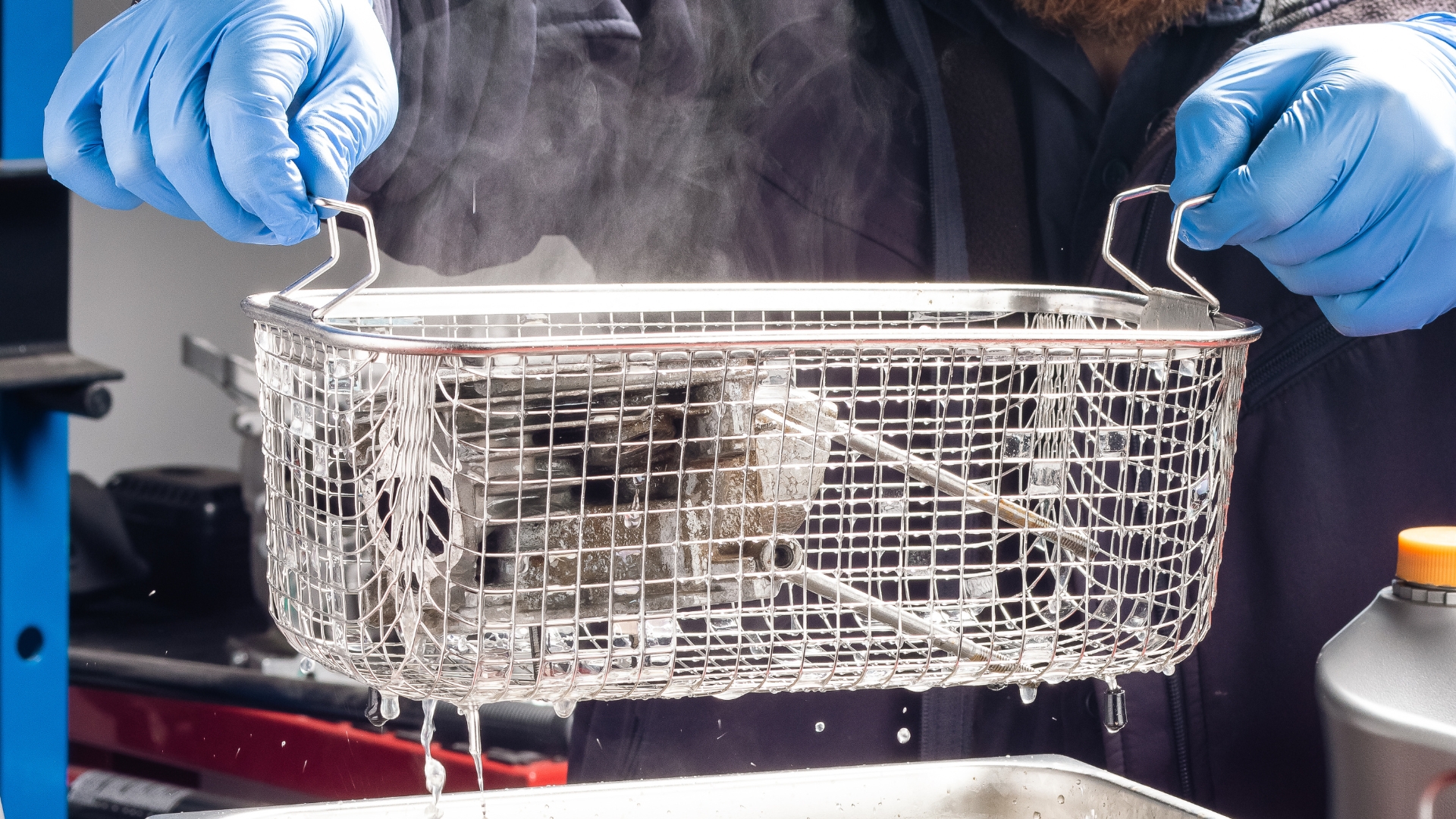
There's a reason surgeons, jewellers, and aircraft mechanics all use the same cleaning technology. Ultrasonic cleaning reaches places brushes, rags, and solvents simply cannot and it does so without damaging delicate components.
The quality of any rebuild, restoration, or repair depends largely on how clean your parts are before reassembly. Here's what you need to know to get it right.
How Ultrasonic Cleaning Works
An ultrasonic cleaner is deceptively simple: a stainless steel tank, a heating element, and transducers mounted to the base. The transducers convert electrical energy into high-frequency sound waves typically 40 kHz that pulse through the cleaning solution.
These sound waves create a phenomenon called cavitation. Millions of microscopic bubbles form and collapse in rmediad succession, generating tiny but powerful shockwaves. Each implosion acts like a miniature scrubbing action, reaching into threads, blind holes, textured surfaces, and crevices that no brush could ever access.
The result is thorough, consistent cleaning without mechanical abrasion. Parts emerge clean, with no risk of scratching or surface damage from manual scrubbing.
Why Heat Matters
Warming the cleaning solution to 50–60°C dramatically improves results. Heat loosens oils, softens carbon deposits, and enhances cavitation intensity. All MAC AFRIC ultrasonic cleaners include integrated heating up to 80°C.
What Can You Clean?
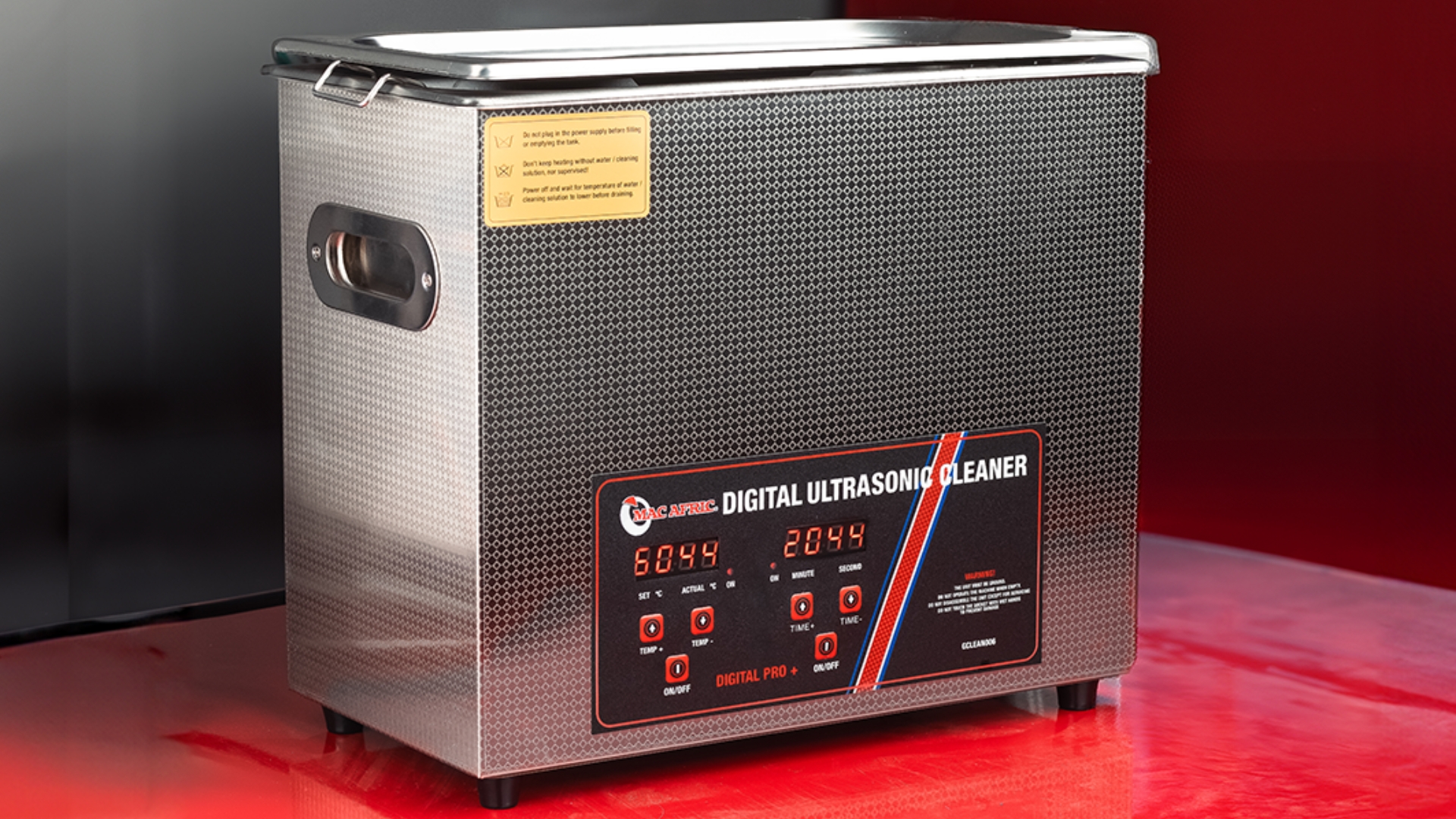
The beauty of ultrasonic cleaning lies in its versatility. From delicate optical lenses to grease-caked carburettors, the process adapts to whatever you put in the tank.
Automotive & Mechanical: Carburettors, fuel injectors, bearings, gears, hydraulic components, brake callipers, turbo parts.
Firearms & Sporting: Gun parts, fishing reels, cycling components, airsoft equipment.
Electronics & Electrical: Circuit boards, connectors, printer heads, sensors, switches.
Medical & Dental: Surgical instruments, dental tools, laboratory equipment, dentures.
Jewellery & Optical: Rings, watches, eyeglasses, camera lenses, precision optics.
Industrial & Workshop: Cutting tools, moulds, dies, valves, filters, gauges, 3D printed parts.
Not Suitable For
Avoid cleaning soft gemstones (pearls, opals, emeralds), items with loose joints or glued components, and materials that react with water unless using appropriate specialised solutions.
MAC AFRIC Ultrasonic Cleaner Range
Adendorff stocks four MAC AFRIC ultrasonic cleaners, from compact benchtop units to industrial-capacity machines. All feature digital controls, adjustable timers, integrated heating, and corrosion-resistant 304 stainless steel construction.
MAC AFRIC 3L Ultrasonic Parts Cleaner
Ideal for jewellery, watch parts, small tools, and electronic components.
| Feature | Specification |
|---|---|
| Capacity | 3 Litres |
| Ultrasonic Power | 120 W |
| Heating Power | 100 W |
| Timer | 0–30 min |
| Temperature Range | 0–80°C |
MAC AFRIC Professional 6L Ultrasonic Cleaner
Professional-grade unit with three transducers for powerful, even cleaning throughout the tank.
| Feature | Specification |
|---|---|
| Capacity | 6 Litres |
| Tank Material | 304 Stainless Steel |
| Ultrasonic Power | 180 W |
| Heating Power | 300 W |
| Transducers | 3 |
| Timer | 0–30 min |
| Temperature Range | 0–80°C |
| Tank Dimensions | 300 × 150 × 150 mm |
| Overall Dimensions | 325 × 175 × 270 mm |
MAC AFRIC 10L Ultrasonic Parts Cleaner
Workshop workhorse for carburettors, injectors, and medium-sized assemblies.
| Feature | Specification |
|---|---|
| Capacity | 10 Litres |
| Ultrasonic Power | 240 W |
| Heating Power | 300 W |
| Timer | 0–30 min |
| Temperature Range | 0–80°C |
MAC AFRIC 30L Ultrasonic Parts Cleaner
Industrial capacity for large components, batch cleaning, and high-volume workshops.
| Feature | Specification |
|---|---|
| Capacity | 30 Litres |
| Ultrasonic Power | 600 W |
| Heating Power | 500 W |
| Timer | 0–30 min |
| Temperature Range | 0–80°C |
Model Comparison
| Model | Capacity | Ultrasonic Power | Heating Power | Best For |
|---|---|---|---|---|
| 3L Cleaner | 3 Litres | 120 W | 100 W | Jewellery, watches, small parts |
| 6L Professional | 6 Litres | 180 W | 300 W | Professional/workshop use |
| 10L Cleaner | 10 Litres | 240 W | 300 W | Carburettors, injectors, tools |
| 30L Cleaner | 30 Litres | 600 W | 500 W | Industrial, batch cleaning |
Swipe to see full table →
How to Use Your Ultrasonic Cleaner
Step 1: Fill the Tank
Add water and the appropriate amount of ultrasonic cleaning solution. Never operate the unit empty this damages the transducers.
Step 2: Set Temperature
Use the TEMP+ and TEMP- buttons to set your desired temperature. For general cleaning, 50–60°C works well. For heavy grease or carbon, go up to 70°C.
Step 3: Set Timer
Use the TIME+ and TIME- buttons to set the cleaning duration. Start with 5–10 minutes for light contamination; stubborn deposits may need 15–30 minutes.
Step 4: Load Parts
Place items in the basket and lower into the tank. Ensure parts are fully submerged. Avoid overcrowding items should not touch each other.
Step 5: Run and Rinse
Press the ultrasonic ON/OFF switch to start. When complete, remove parts, rinse with clean water, and dry thoroughly. For heavily soiled items, repeat if needed.
Pro Tip: Degassing
Fresh solution contains dissolved air that reduces cleaning efficiency. Run the ultrasonic without parts for 5–10 minutes before your first cleaning session, or press the ON/OFF switch three times quickly to activate the degassing function (cycles 6 seconds on, 3 seconds off).
Maintenance
After each session, allow the solution to cool below 40°C before draining. Wipe the tank and exterior with a clean cloth. Store in a dry location. Replace cleaning solution when it becomes visibly contaminated or cleaning performance drops.
Important Safety Notes
Never use flammable cleaning agents. Do not run the heater or ultrasonic without liquid in the tank. Prevent liquid from splashing onto the control panel or into the chassis this can cause short circuits and damage electronic components. Keep continuous operation under 60 minutes to prevent overheating.
Cleaning Solutions
While water alone can handle light dust and fingerprints, proper ultrasonic cleaning solution makes a significant difference. These formulations are designed to enhance cavitation, emulsify oils, and lift contaminants without damaging parts or the tank.
MAC AFRIC Ultrasonic Cleaning Solution
Concentrated formula dilute according to contamination level. Safe for metals, plastics, glass, and ceramics.
See It in Action
Ultrasonic Cleaner Unboxing and Test
See an ultrasonic cleaner put through its paces setup, first use, and real results:
Testing Adendorff's Ultrasonic Cleaning Fluid
Watch the MAC AFRIC cleaning solution in action on real parts:
Frequently Asked Questions
A: Ultrasonic cleaners are ideal for jewellery, tools, lab instruments, medical devices, automotive parts, carburettors, fuel injectors, bearings, optical lenses, circuit boards, firearms, and intricate industrial components. Essentially, anything that can be safely submerged in water-based solution.
A: The cleaner uses high-frequency sound waves (typically 40 kHz) to create ultrasonic cavitation millions of microscopic bubbles that form and implode in the cleaning solution. These implosions generate powerful scrubbing action that removes dirt, grime, oil, and residues from surfaces and crevices.
A: While not essential, the integrated heater (up to 80°C) significantly enhances cleaning results. Heat loosens stubborn contaminants like grease, carbon deposits, and baked-on oils. For best results, operate between 50–60°C for general cleaning.
A: Yes. MAC AFRIC ultrasonic cleaners feature digital control panels allowing temperature settings from 0°C to 80°C and cleaning cycles from 1 to 30 minutes. This lets you tailor the process to specific parts and contamination levels.
A: MAC AFRIC ultrasonic cleaner tanks and baskets are made of high-quality 304 stainless steel. This provides excellent corrosion resistance and durability for long-term use with various cleaning solutions.
A: For best results, yes. Water alone can handle light contamination, but proper ultrasonic cleaning solution dramatically improves performance on oils, grease, and carbon. Adendorff offers concentrated MAC AFRIC cleaning solution in 1 litre and 5 litre bottles.
A: Choose based on the largest parts you clean regularly. The item must fit fully submerged in the tank. The 3L suits jewellery and small components. The 6L and 10L handle most workshop needs including carburettors and tools. The 30L is for industrial use and batch cleaning.
A: Start with 5–10 minutes for lightly soiled items. Heavily contaminated parts may need 15–30 minutes. Avoid continuous operation beyond 60 minutes this can cause heat build-up and accelerate component wear.
Products Featured:
- MAC AFRIC 3L Ultrasonic Parts Cleaner
- MAC AFRIC Professional 6L Ultrasonic Cleaner with Heating and Digital Timer
- MAC AFRIC 10L Ultrasonic Parts Cleaner
- MAC AFRIC 30L Ultrasonic Parts Cleaner
- MAC AFRIC Ultrasonic Cleaning Solution – 1 Litre
- MAC AFRIC Ultrasonic Cleaning Solution – 5 Litre
Shop the Full Range
Browse all MAC AFRIC ultrasonic cleaners and cleaning solutions at your nearest Adendorff store or online at adendorff.co.za.