
MAC AFRIC 2600W Cold Metal Saw: Operation Manual Guide
MAC AFRIC 2600W Cold Metal Saw: Operation Manual Guide
Model: ECUTLD050
DANGER! Read all safety regulations and instructions.
Keep all safety regulations and instructions in a safe place for future use.
SUPPLIED BY
Adendorff machinery mart
www.adendorff.co.za
Index
- General Power Tool Safety Warnings
- Workplace safety
- Electrical safety
- Personal safety
- Power tool use and care
- Service
- Safety regulations for metal saw
- Product and Performance Description
- Product Diagram
- Scope of use
- Technical parameters
- Cutting capacity
- Operation
- Installation
- Cutting
- Transportation
- Maintenance and repair
- Warranty terms
- Exploded diagram
- Parts list
I. General Power Tool Safety Warnings
WARNING!
Read all safety warnings, instructions, illustrations and specifications provided with this power tool. Failure to follow all instructions listed below may result in electric shock, fire and/or serious injury.
Save all warnings and instructions for future reference.
The term "power tool" in the warnings refers to your mains-operated (corded) power tool or battery-operated (cordless) power tool.
(1) Workplace safety
- a) Keep work area clean and well lit. Cluttered or dark areas invite accidents.
- b) Do not operate power tools in explosive atmospheres, such as in the presence of flammable liquids, gases or dust. Power tools create sparks which may ignite the dust or fumes.
- c) Keep children and bystanders away while operating a power tool. Distractions can cause you to lose control.
(2) Electrical safety
- a) Power tool plugs must match the outlet. Never modify the plug in any way. Do not use any adapter plugs with earthed (grounded) power tools. Unmodified plugs and matching outlets will reduce risk of electric shock.
- b) Avoid body contact with earthed or grounded surfaces, such as pipes, radiators, ranges and refrigerators. There is an increased risk of electric shock if your body is earthed or grounded.
- c) Do not expose power tools to rain or wet conditions. Water entering a power tool will increase the risk of electric shock.
- d) Do not abuse the cord. Never use the cord for carrying, pulling or unplugging the power tool. Keep cord away from heat, oil, sharp edges or moving parts. Damaged or entangled cords increase the risk of electric shock.
- e) When operating a power tool outdoors, use an extension cord suitable for outdoor use. Use of a cord suitable for outdoor use reduces the risk of electric shock.
- f) If operating a power tool in a damp location is unavoidable, use a residual current device (RCD) protected supply. Use of an RCD reduces the risk of electric shock.
(3) Personal safety
- a) Stay alert, watch what you are doing and use common sense when operating a power tool. Do not use tool while you are tired or under the influence of drugs, alcohol or medication. A moment of inattention while operating power tools may result in serious personal injury.
- b) Use personal protective equipment. Always wear eye protection. Protective equipment such as dust mask, non-skid safety shoes, hard hat, or hearing protection used for appropriate conditions will reduce personal injuries.
- c) Prevent unintentional starting. Ensure the switch is in the off-position before connecting to power source and/or battery pack, picking up or carrying the tool. Carrying power tools with your finger on the switch or energising power tools that have the switch on invites accidents.
- d) Remove any adjusting key or wrench before turning the power tool on. A wrench or a key left attached to a rotating part of the power tool may result in personal injury.
- e) Do not overreach. Keep proper footing and balance at all times. This enables better control of the power tool in unexpected situations.
- f) Dress properly. Do not wear loose clothing or jewellery. Keep your hair, clothing and gloves away from moving parts. Loose clothes, jewellery or long hair can be caught in moving parts.
- g) If devices are provided for the connection of dust extraction and collection facilities, ensure these are connected and properly used. Use of dust collection can reduce dust-related hazards.
- h) Do not let familiarity gained from frequent use of tools allow you to become complacent and ignore tool safety principles. A careless action can cause severe injury within a fraction of a second.
(4) Power tool use and care
- a) Do not force the power tool. Use the correct power tool for your application. The correct power tool will do the job better and safer at the rate for which it was designed.
- b) Do not use the power tool if the switch does not turn it on and off. Any power tool that cannot be controlled with the switch is dangerous and must be repaired.
- c) Disconnect the plug from the power source and/or the battery pack, if detachable, from the power tool before making any adjustments, changing accessories, or storing power tools. Such preventive safety measures reduce the risk of starting the power tool accidentally.
- d) Store idle power tools out of the reach of children and do not allow persons unfamiliar with the power tool or these instructions to operate the power tool. Power tools are dangerous in the hands of untrained users.
- e) Maintain power tools and accessories. Check for misalignment or binding of moving parts, breakage of parts and any other condition that may affect the power tool's operation. If damaged, have the power tool repaired before use. Many accidents are caused by poorly maintained power tools.
- f) Keep cutting tools sharp and clean. Properly maintained cutting tools with sharp cutting edges are less likely to bind and are easier to control.
- g) Use the power tool, accessories and tool bits etc. in accordance with these instructions, taking into account the working conditions and the work to be performed. Use of the power tool for operations different from those intended could result in a hazardous situation.
- h) Keep handles and grasping surfaces dry, clean and free from oil and grease.
(5) Service
- a) Have your power tool serviced by a qualified repair person using only identical replacement parts. This will ensure that the safety of the power tool is maintained.
WARNING
If the replacement of the supply cord is necessary, this has to be done by the manufacturer or his agent in order to avoid a safety hazard.
WARNING
- The declared noise emission value(s) have been measured in accordance with a standard test method and may be used for comparing one tool with another.
- The declared noise emission value(s) may also be used in a preliminary assessment of exposure.
- The noise emissions during actual use of the power tool can differ from the declared values depending on the ways in which the tool is used especially what kind of work piece is processed.
- This is a need to identify safety measures to protect the operator that are based on an estimation of exposure in the actual conditions of use (taking account of all parts of the operating cycle such as the times when the tool is switched off and when it is running idle in addition to the trigger time).
II. Safety regulations for metal saw
1) Metal saw safety warnings
- a) Position yourself and bystanders away from the plane of the rotating wheel. The guard helps to protect operator from broken wheel fragments and accidental contact with wheel.
- b) Use only bonded reinforced or diamond cut-off wheels for your power tool. Just because an accessory can be attached to your power tool, it does not assure safe operation.
- c) The rated speed of the accessory must be at least equal to the maximum speed marked on the power tool. Accessories running faster than their rated speed can break and fly apart.
- d) Wheels must be used only for recommended applications. For example: do not grind with the side of a cut-off wheel. Abrasive cut-off wheels are intended for peripheral grinding, side forces applied to these wheels may cause them to shatter.
- e) Always use undamaged wheel flanges that are of correct diameter for your selected wheel. Proper wheel flanges support the wheel thus reducing the possibility of wheel breakage.
- f) The outside diameter and the thickness of your accessory must be within the capacity rating of your power tool. Incorrect sized accessories cannot be adequately guarded or controlled.
- g) The arbor size of wheels and flanges must properly fit the spindle of the power tool. Wheels and flanges with arbor holes that do not match the mounting hardware of the power tool will run out of balance, vibrate excessively and may cause loss of control.
- h) Do not use damaged wheels. Before each use, inspect the wheels for chips and cracks. If the power tool or wheel is dropped, inspect for damage or install an undamaged wheel. After inspecting and installing the wheel, position yourself and bystanders away from the plane of the rotating wheel and run the power tool at maximum no load speed for one minute. Damaged wheels will normally break apart during this test time.
- i) Wear personal protective equipment. Depending on application, use face shield, safety goggles or safety glasses. As appropriate, wear dust mask, hearing protectors, gloves and shop apron capable of stopping small abrasive or workpiece fragments. The eye protection must be capable of stopping flying debris generated by various operations. The dust mask or respirator must be capable of filtering particles generated by your operation. Prolonged exposure to high intensity noise may cause hearing loss.
- j) Keep bystanders a safe distance away from work area. Anyone entering the work area must wear personal protective equipment. Fragments of workpiece or of a broken wheel may fly away and cause injury beyond immediate area of operation.
- k) Position the cord clear of the spinning accessory. If you lose control, the cord may be cut or snagged and your hand or arm may be pulled into the spinning wheel.
- l) Regularly clean the power tool's air vents. The motor's fan can draw the dust inside the housing and excessive accumulation of powdered metal may cause electrical hazards.
- m) Do not operate the power tool near flammable materials. Sparks could ignite these materials.
- n) Do not use accessories that require liquid coolants. Using water or other liquid coolants may result in electrocution or shock.
2) Kickback and related warnings
Kickback is a sudden reaction to a pinched or snagged rotating wheel. Pinching or snagging causes rapid stalling of the rotating wheel which in turn causes the uncontrolled cutting unit to be forced upwards toward the operator. For example, if an abrasive wheel is snagged or pinched by the workpiece, the edge of the wheel that is entering into the pinch point can dig into the surface of the material causing the wheel to climb out or kick out. Abrasive wheels may also break under these conditions. Kickback is the result of power tool misuse and/or incorrect operating procedures or conditions and can be avoided by taking proper precautions as given below.
- a) Maintain a firm grip on the power tool and position your body and arm to allow you to resist kickback forces. The operator can control upward kickback forces, if proper precautions are taken.
- b) Do not position your body in line with the rotating wheel. If kickback occurs, it will propel the cutting unit upwards toward the operator.
- c) Do not attach a saw chain, woodcarving blade, segmented diamond wheel with a peripheral gap greater than 10 mm or toothed saw blade. Such blades create frequent kickback and loss of control.
- d) Do not "jam" the wheel or apply excessive pressure. Do not attempt to make an excessive depth of cut. Overstressing the wheel increases the loading and susceptibility to twisting or binding of the wheel in the cut and the possibility of kickback or wheel breakage.
- e) When the wheel is binding or when interrupting a cut for any reason, switch off the power tool and hold the cutting unit motionless until the wheel comes to a complete stop. Never attempt to remove the wheel from the cut while the wheel is in motion otherwise kickback may occur. Investigate and take corrective action to eliminate the cause of wheel binding.
- f) Do not restart the cutting operation in the workpiece. Let the wheel reach full speed and carefully re-enter the cut. The wheel may bind, walk up or kickback if the power tool is restarted in the workpiece.
- g) Support any oversized workpiece to minimize the risk of wheel pinching and kickback. Large workpieces tend to sag under their own weight. Supports must be placed under the workpiece near the line of cut and near the edge of the workpiece on both sides of the wheel.
3) Stability and related warnings
Ensure that the metal saw is always used on a stable and level surface. If used on a workbench or the like, please use a safety chain to avoid its dropping from the surface.
— that noise emissions during actual use of the power tool can differ from the declared values depending on the ways in which the tool is used especially what kind of workpiece is processed; and
— the need to identify safety measures to protect the operator that are based on an estimation of exposure in the actual conditions of use (taking account of all parts of the operating cycle such as the times when the tool is switched off and when it is running idle in addition to the trigger time).
III. Product and Performance Description
(1) Product Diagram
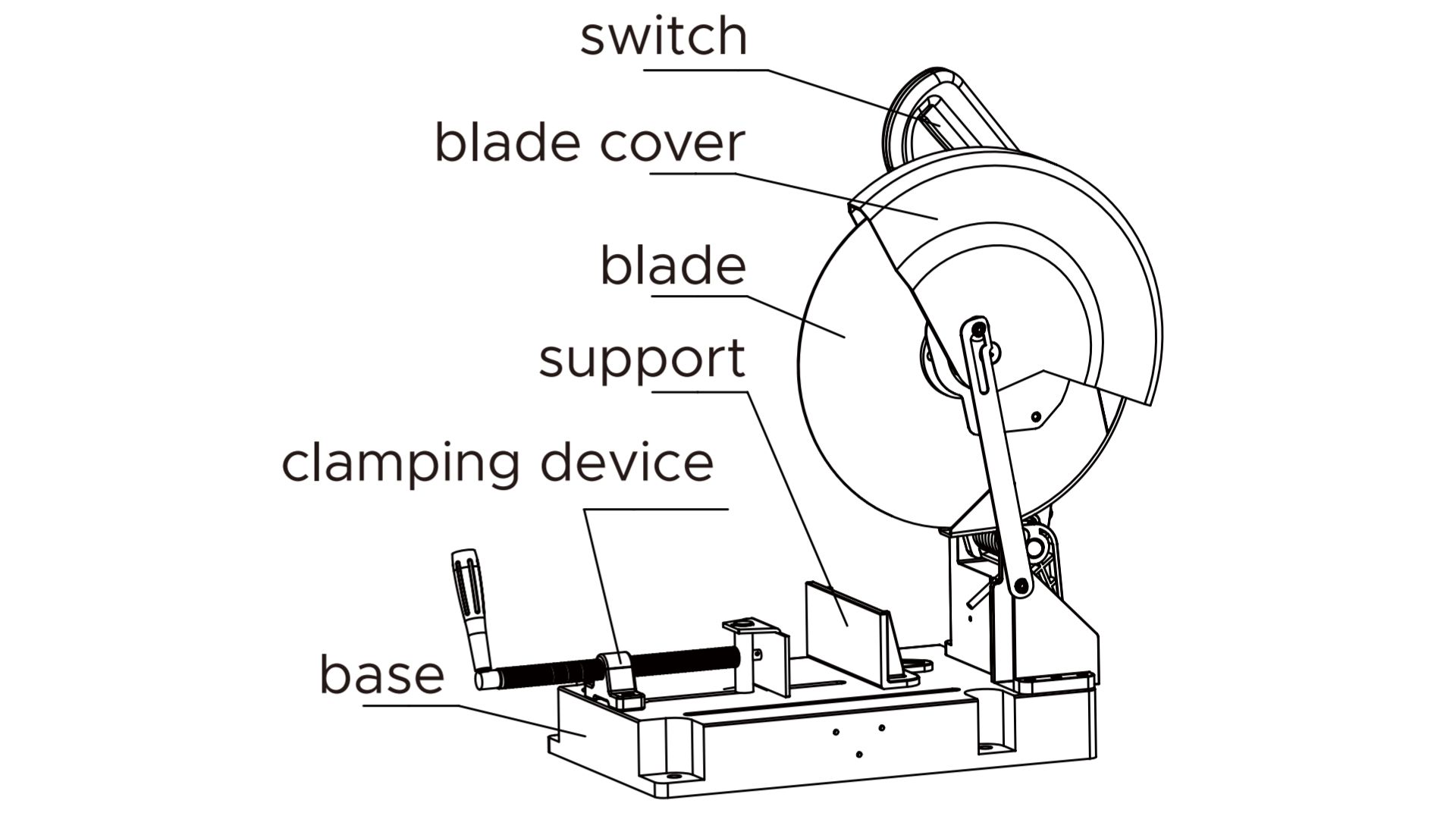
(2) Scope of use
This product has a wide range of applications and can completely replace profile machines, aluminum sawing machines, etc. The following materials are suitable for this machine: angle steel, square steel, channel steel, round steel, square steel tube, aluminum tube, H-beam, C-shaped steel, I-beam, rebar, large aluminum profiles, etc.
Prohibited materials:
1. Hollow thin-walled stainless steel.
2. Metal materials with chrome plating.
3. Metal materials with quenched hardness.
4. Special materials such as pig iron and steel wire.
(3) Technical parameters
| Product name | Metal saw |
| Model no. | 355 |
| Type of saw | Metal saw for metal |
| Rated voltage/frequency | 230V~50Hz |
| Rated power | 2600W |
| Blade diameter | 355mm |
| Blade shaft hole diameter | 25.4mm |
| Thickness of blade teeth | 2.2mm |
| Sound pressure level | 105.5dB(A) K=3.0dB(A) |
| Sound power level | 112.9dB(A) K=3.0dB(A) |
(4) Maximum cutting capacities
| Workpiece shape | Cutting angle 0° | Cutting angle 45° |
|---|---|---|
| ○ | Φ120mm | Φ100mm |
| □ | 120x120mm | 100x100mm |
| ▭ | 120x170mm | 95x100mm |
| ∧ | 120x120mm | 70x70mm |
IV. Operation
(1) Installation
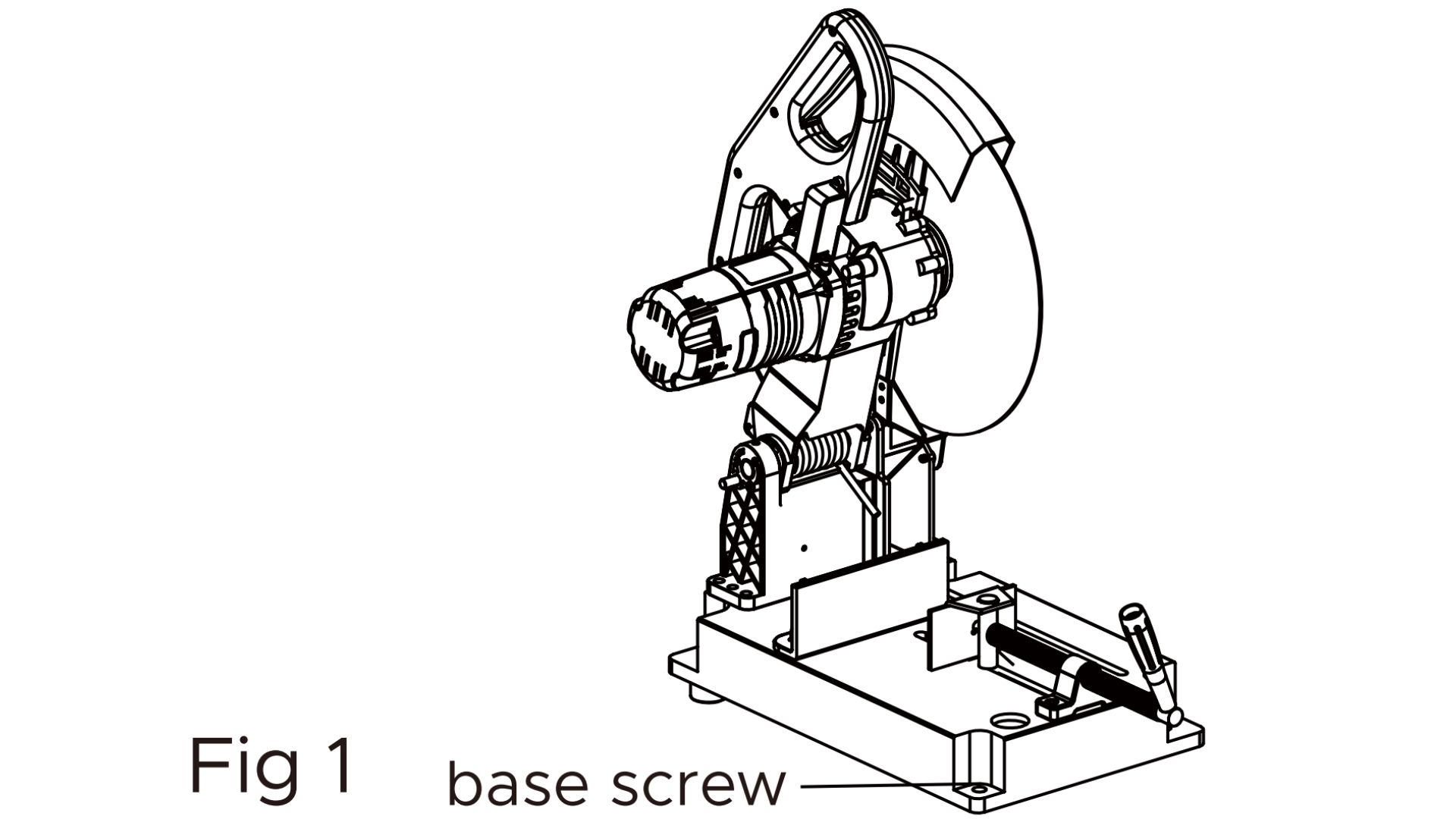
In order to operate the machine stably, the machine must be fixed on a flat and stable working surface (such as a workbench) before use. Fix it on the working surface with appropriate bolts (Figure 1).
Replace the saw blade
Warning
Before disassembling or installing the saw blade, please make sure that the machine's switch is turned off and the power plug is unplugged. When operating, please wear protective gloves to avoid injury.
Disassemble the saw blade
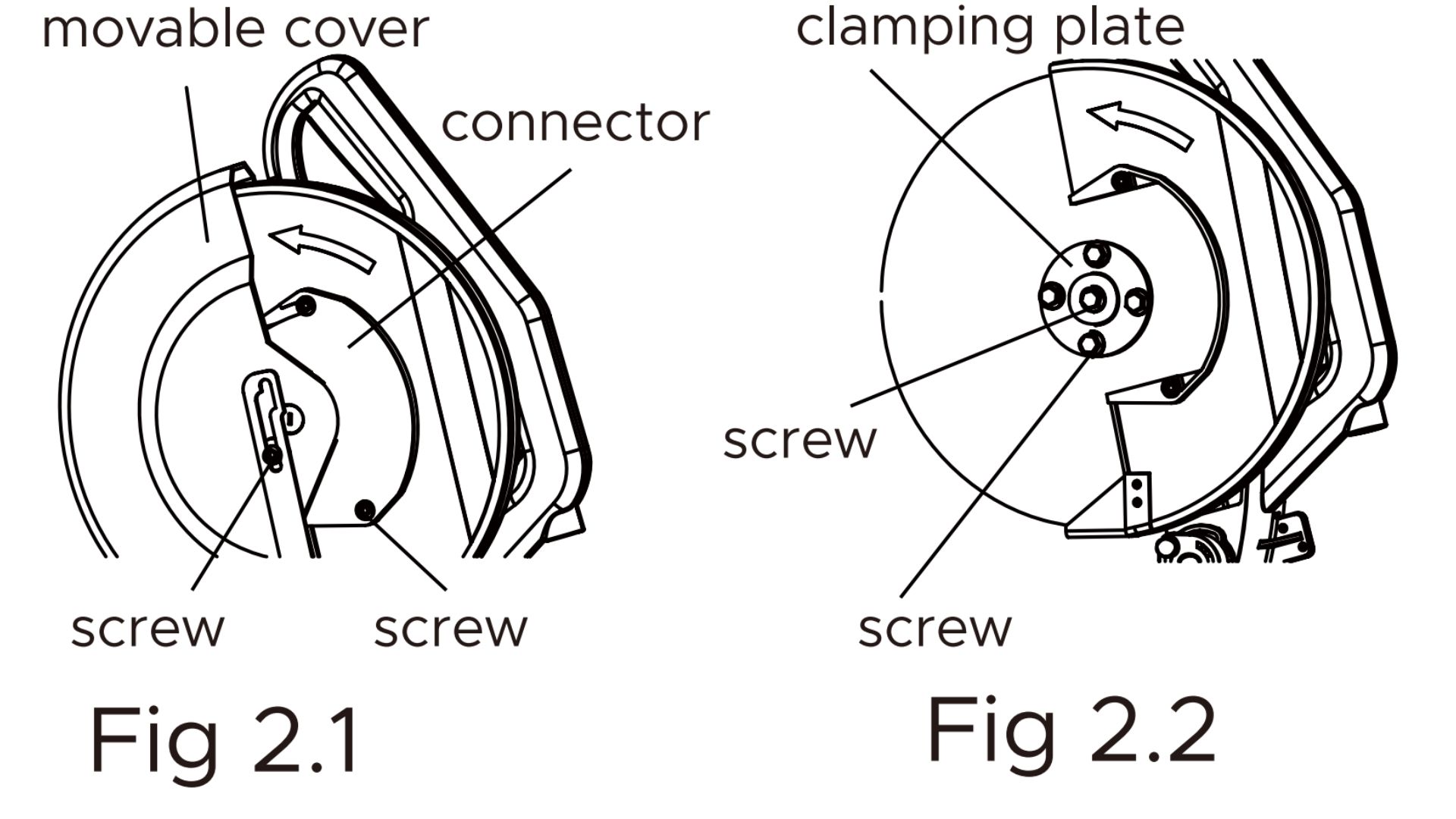
- When it is necessary to remove the saw blade, use an hex wrench to loosen the screws from the movable cover and cover connector and then remove the movable cover (Figure 2.1) to expose the clamping plate (Figure 2.2).
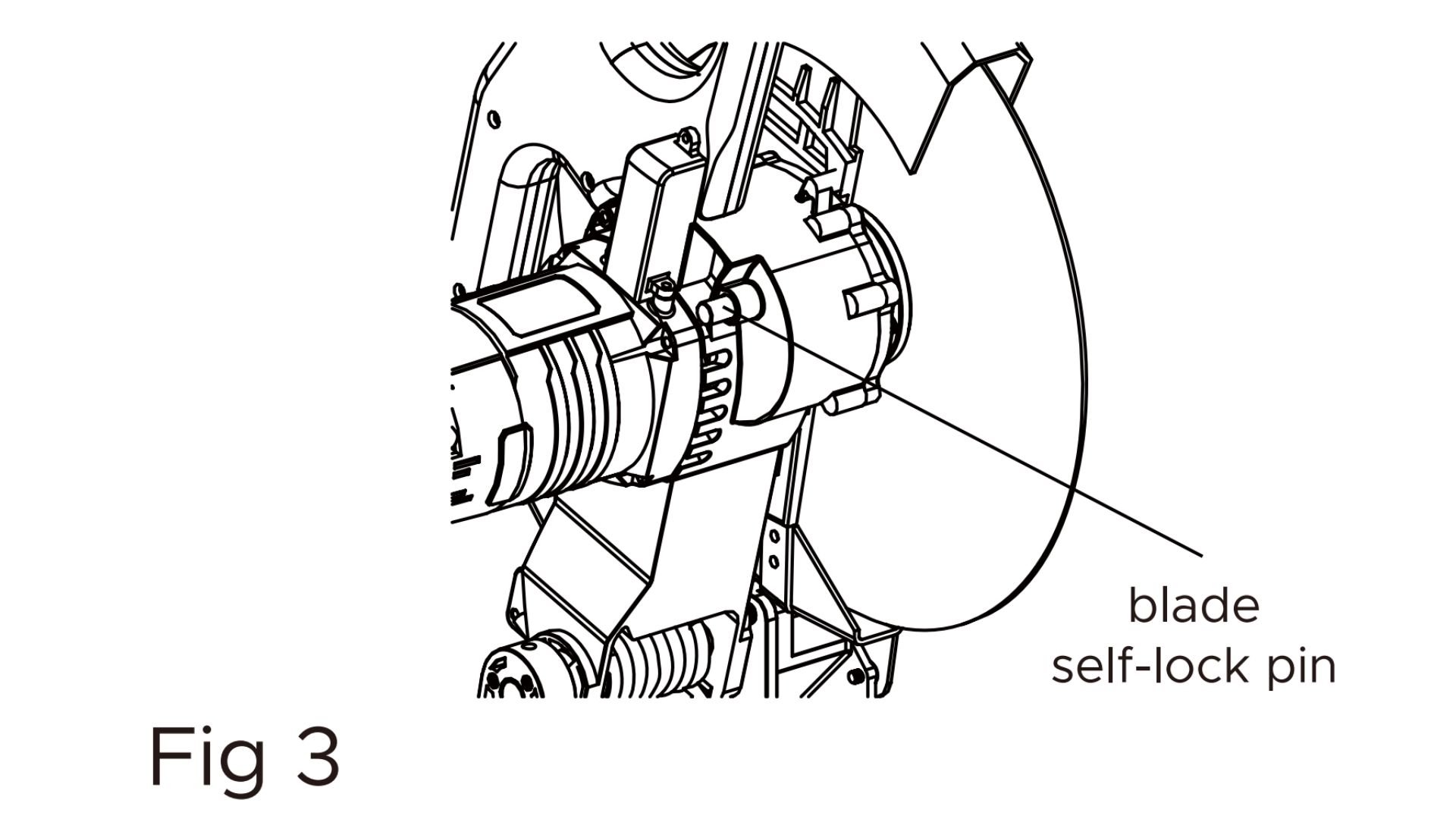
- Press the locking device (self-locking pin) of the spindle to prevent the shaft from rotating, then use a hex wrench to loosen the screw of the saw blade clamping plate and remove the blade (Figure 3).
Install the saw blade
- Confirm that the direction of the arrow on the saw blade is in line with the one on the protective cover.
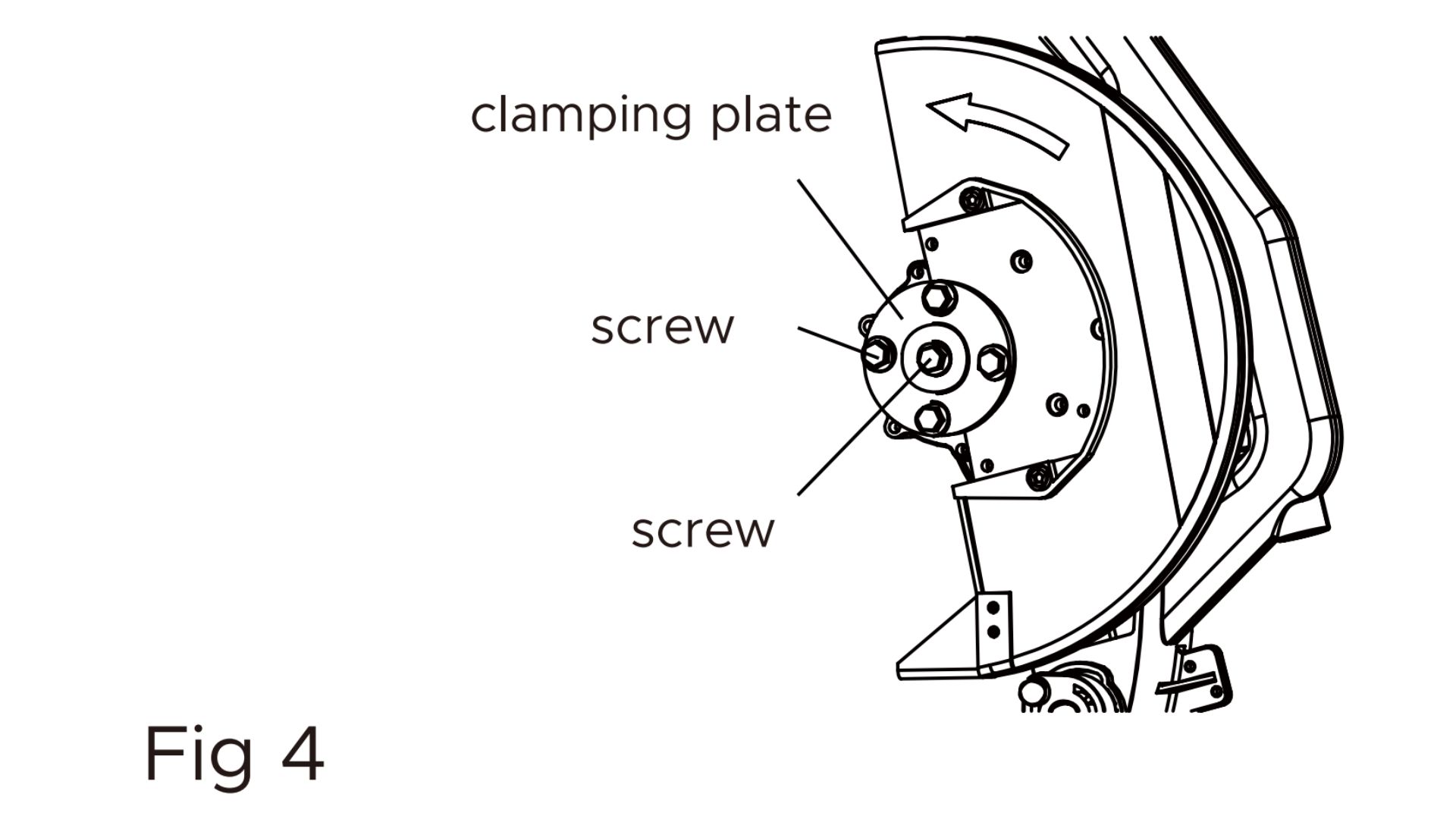
- Confirm that the saw blade is flat and installed on the spindle. Reinstall the clamping plate and tighten the screws with a hex wrench (Figure 4).
- Reinstall the protective cover and tighten the screws.
- Confirm whether the self-locking pin has rebounded.
(2) Cutting
Fix the workpiece
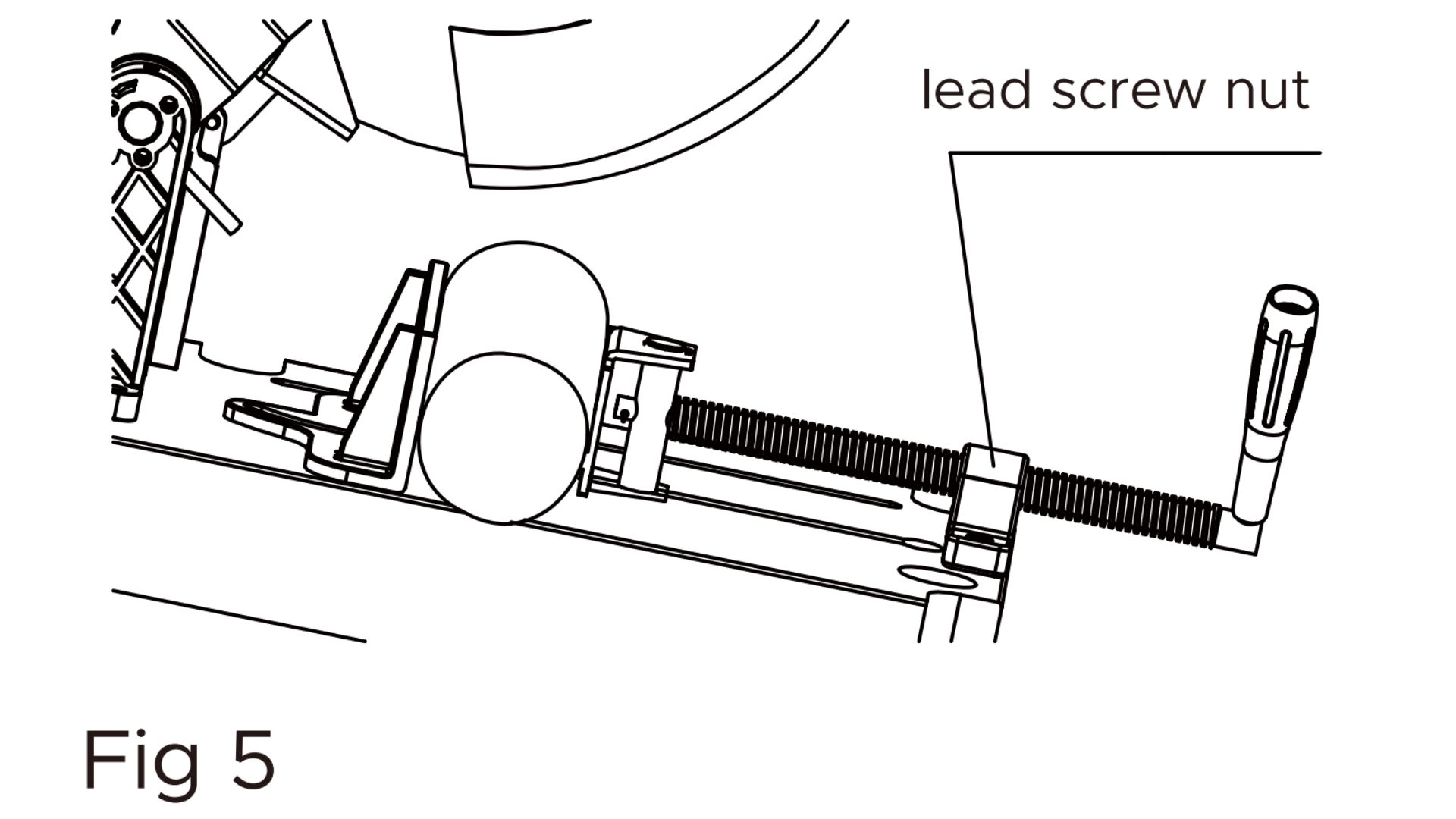
To ensure safety, it is essential to fix the workpiece securely. Place the workpiece on the angle baffle, push the screw rod onto the workpiece, lock the quick clamp and tighten the screw rod to firmly clamp the workpiece (Figure 5).
Start cutting
- Hold the handle firmly and press the switch to start the machine.
- Wait until the saw blade reaches full speed before slowly lowering it to contact the workpiece.
- Apply steady and even pressure. Do not force the blade into the material.
- After cutting is completed, release the switch and wait until the blade comes to a complete stop before raising it.
Warning
Do not attempt to cut extremely small workpieces that cannot be properly secured. Do not cut magnesium materials. Do not overload the machine. Never remove the safety guard during operation.
(3) Transportation
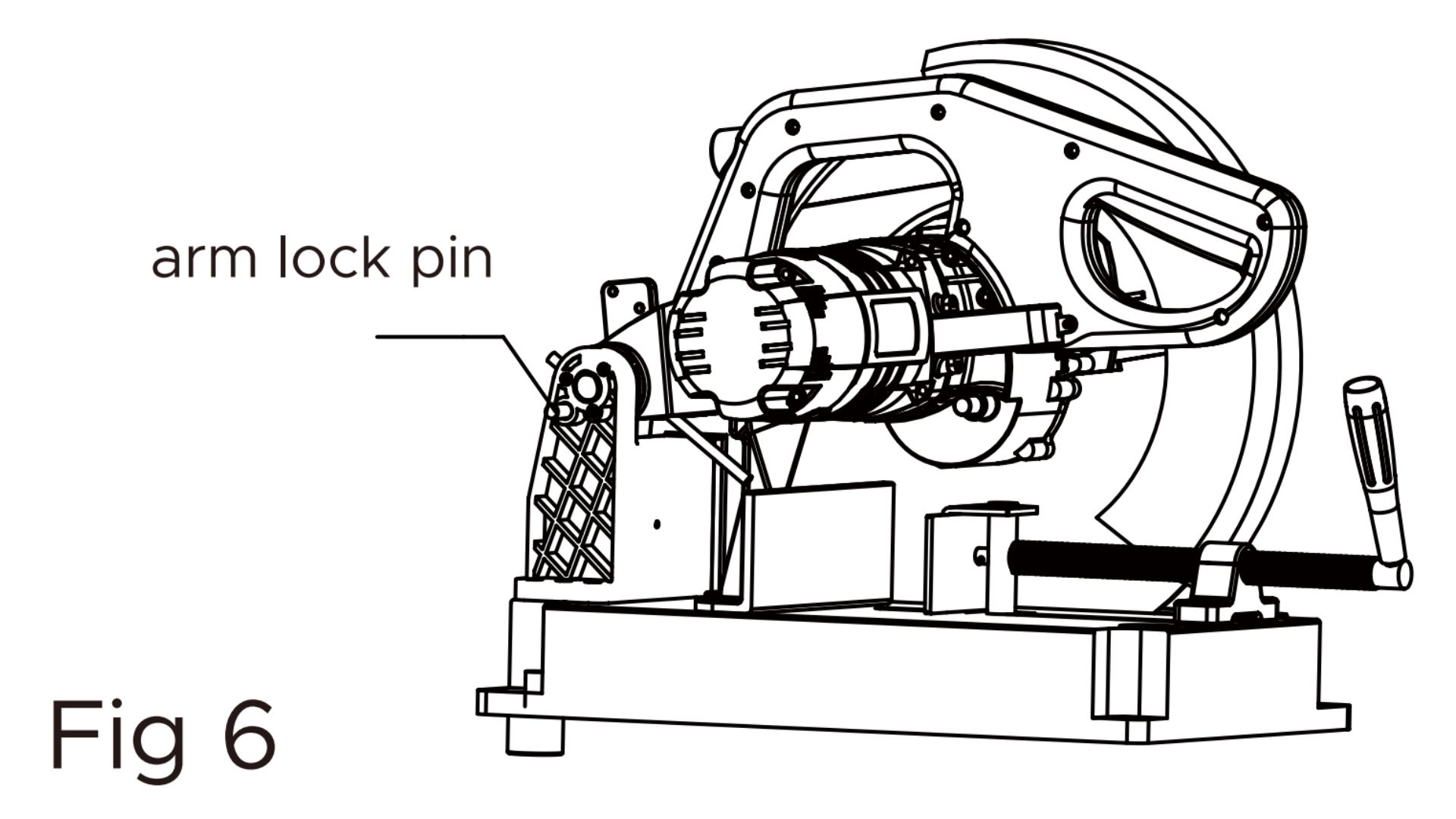
- Before transporting the machine, gently lower the arm, press the arm lock to lock the arm (Figure 6).
- Always lift the machine by its arm, do not use wires to pull or drag the machine.
(4) Inspection and Calibration
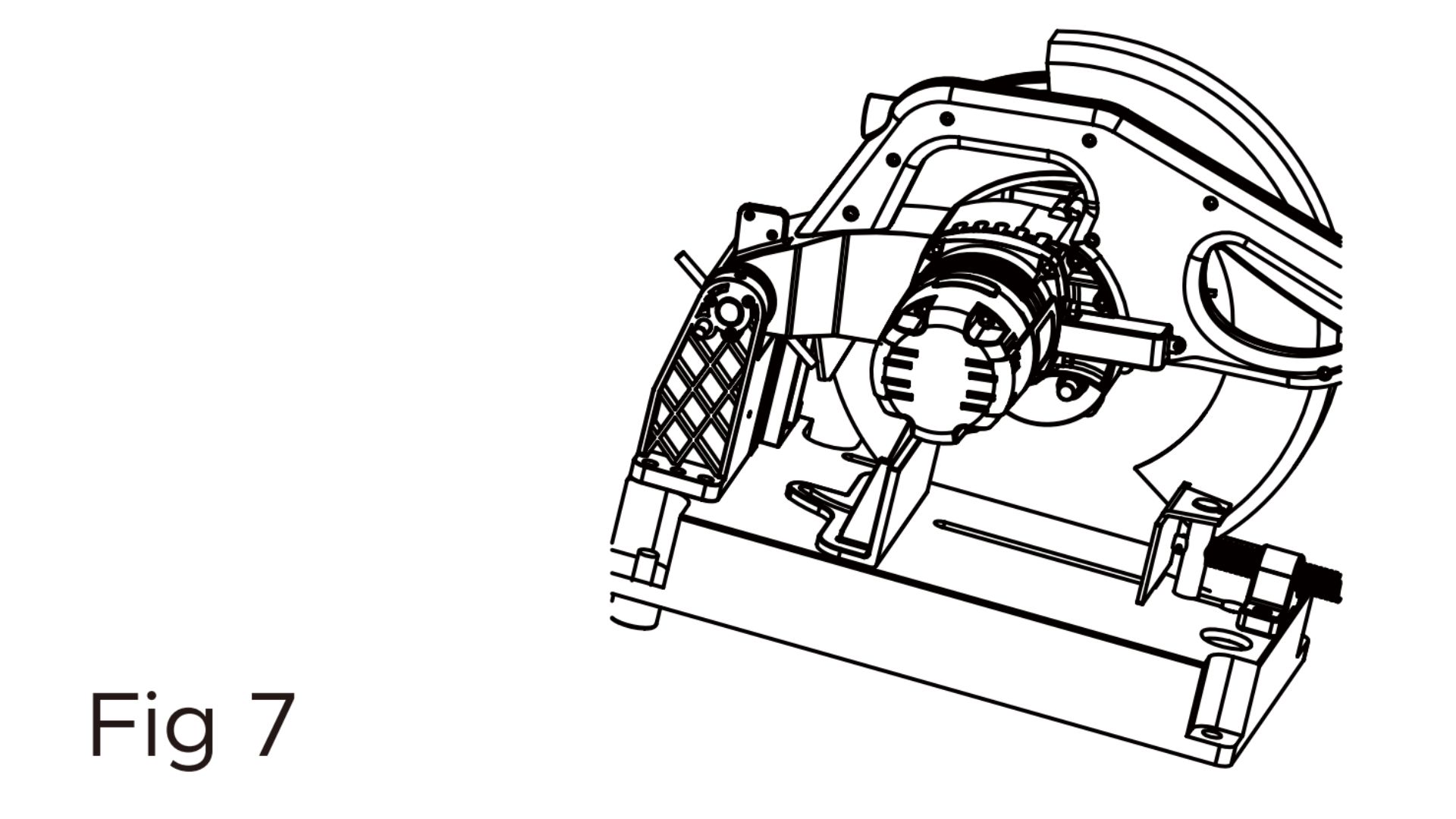
Regularly inspect the machine. If there is a deviation in accuracy after long-term use, the following steps can be taken for adjustment: Firstly, lower and lock the arm. Release the quick clamp so the baffle can move freely. Use an angle ruler to adjust the baffle while leaning against the saw blade to make it 90 degrees. Then, turn the locking wrench clockwise to lock the baffle and loosen the fixing screw of the angle pointer, aligning the angle pointer with the 0 degree scale line (Figure 7).
V. Maintenance and repair
Before performing any maintenance or other work on the machine, please make sure to turn off the machine switch and unplug the machine.
- Regularly maintain the machine. Remove dust, oil stains, etc. from the machine to keep it clean.
- Regularly check the screws of each connecting part to ensure that they are not loose. Inspect the parts of the machine for any damage.
- If the machine malfunctions, please hand it over to professional maintenance personnel for repair and replace broken parts with original ones.
VI. Warranty terms
All MAC AFRIC tools and machinery come with a 1-year carry-in warranty against manufacturer and material defects. Should your product malfunction under normal use, it will be repaired or replaced free of charge at Adendorff’s discretion. Products must be returned with the original invoice and packaging within 10 days for refunds or exchanges. The warranty excludes faults due to misuse, neglect, unauthorized repairs, wear and tear, power surges, lightning, or use against manual instructions. Generators must be installed by a qualified electrician with a valid Certificate of Compliance, or the warranty is void. A 3-month warranty applies to all repairs, and large generators carry a warranty of 1 year or 300 hours, whichever comes first. Cross-border purchases must be returned to South Africa at the customer’s cost. Terms align with CPA regulations. For more, visit www.adendorff.co.za.
Exploded diagram
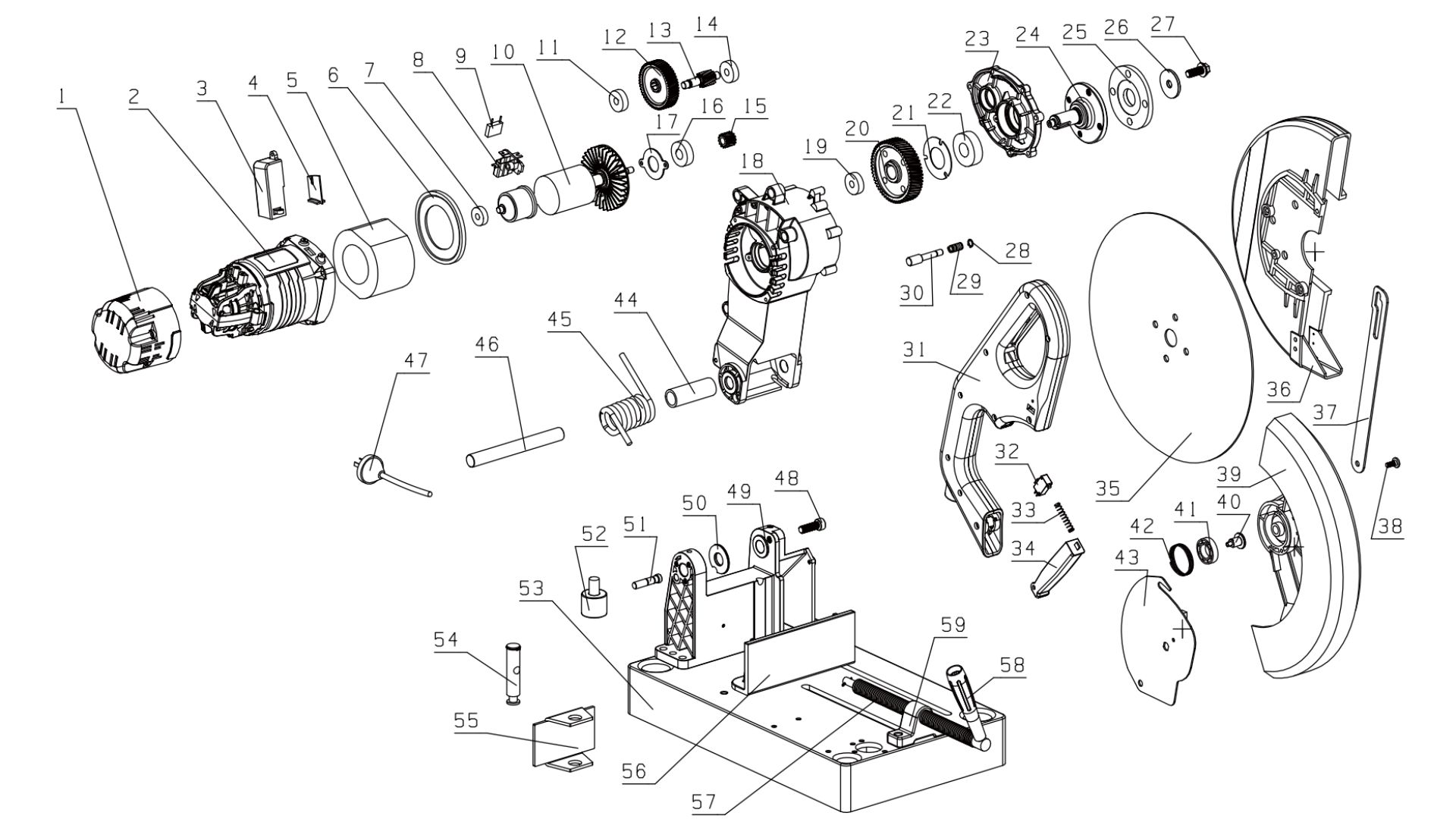
Parts list
| No. | Part Name | No. | Part Name |
|---|---|---|---|
| 1 | motor cover | 31 | handle |
| 2 | motor housing | 32 | switch |
| 3 | wire protector | 33 | switch spring |
| 4 | spacer | 34 | switch trigger |
| 5 | stator | 35 | blade |
| 6 | windshield ring | 36 | fixed blade cover |
| 7 | 629 bearing | 37 | shaft |
| 8 | carbon brush housing | 38 | shaft screw |
| 9 | carbon brush | 39 | movable blade cover |
| 10 | rotor | 40 | screw |
| 11 | 6200 bearing | 41 | washer |
| 12 | 2# gear | 42 | spring |
| 13 | 3# gear | 43 | cover fixer |
| 14 | 6200 bearing | 44 | shaft sleeve |
| 15 | 1# gear | 45 | recover spring |
| 16 | 6202 bearing | 46 | supporting shaft |
| 17 | bearing fixer D44 | 47 | power cable |
| 18 | moving arm | 48 | M10*30 screw |
| 19 | 6200 bearing | 49 | bracket |
| 20 | 4# gear | 50 | adjustment washer |
| 21 | bearing fixer D60 | 51 | locking pin |
| 22 | 6204 bearing | 52 | supporting leg |
| 23 | bearing front cover | 53 | base |
| 24 | output shaft | 54 | D18 pin |
| 25 | blade clamping plate | 55 | clamping plate |
| 26 | washer | 56 | support |
| 27 | M10 screw | 57 | lead screw |
| 28 | D8 snap ring | 58 | lead screw handle |
| 29 | D8 spring | 59 | lead screw nut |
| 30 | blade self-lock pin |
DANGER! Read all safety regulations and instructions.
Keep all safety regulations and instructions in a safe place for future use.
Supplied by:
Adendorff Machinery Mart
98 Sailor Malan Avenue, Aeroton, Johannesburg, 2190
www.adendorff.co.za