How to Reach and Remove Stripped Hex Screws: The MAC AFRIC Long Arm Ball-end Key Set
How to Reach and Remove Stripped Hex Screws: The MAC AFRIC Long Arm Ball-end Key Set
Two things turn a simple hex screw into a problem: you cannot reach it squarely, or the socket has already rounded off. A short Allen key that will not line up with a recessed bolt, or a key that just spins inside a worn, chewed socket, are everyday frustrations for mechanics, fitters, and anyone who works on machinery.
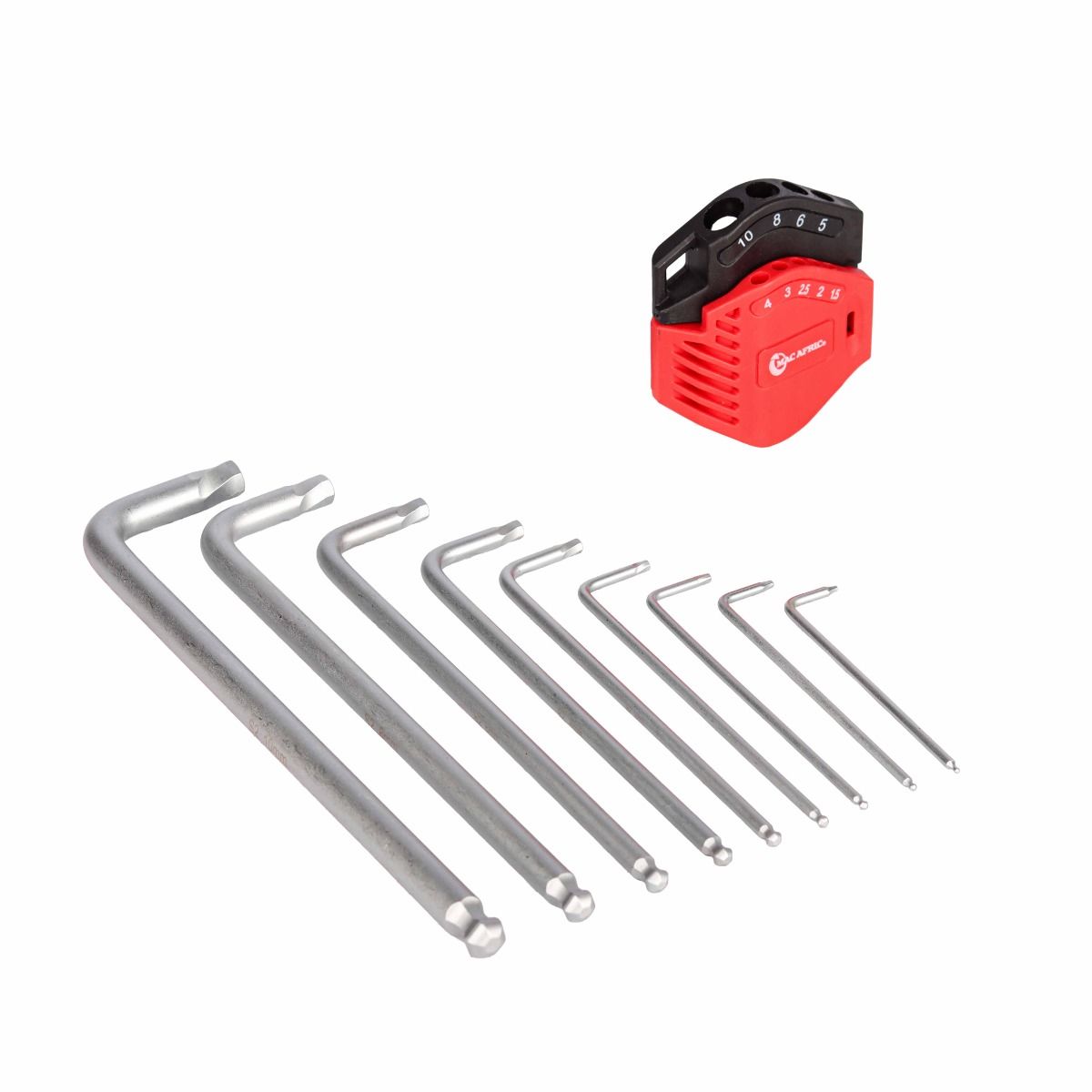
The MAC AFRIC Long Arm Ball-end Key Set (SKU TKEYSA003) is built for exactly those two situations. It is a nine-piece set of extra-long, two-way hex wrenches: a ball head on the long end for angled access, and a spiral extractor on the short end for screws that have started to strip. This guide explains how each end works, what the S2 steel and long-arm design give you in practice, and how to free a rounded hex screw step by step.
What You'll Learn in This Guide
MAC AFRIC Long Arm Ball-end Key Set
Nine extra-long, two-way hex keys in S2 steel. The long end carries a ball head for turning fasteners at an angle, while the short end is a twisted spiral extractor that grips worn or damaged sockets. Supplied in a compact, labelled holder for size identification and storage.
Key specs: 9 pieces • 1.5 mm to 10 mm • S2 steel, HRC 56 to 60 • Sandblasted matte finish • Ball-end and spiral extractor ends
What is a ball-end Allen key used for?
A ball-end Allen key lets you turn a fastener while the key sits at an angle, instead of needing it dead square in the socket. That is the whole point of the rounded tip on the long end of each key. A standard hex key has to sit perfectly in line with the screw, and the moment you tilt off that line, the corners slip. The ball end keeps engaging the socket on a slant, which is the difference between reaching a bolt tucked behind a bracket and giving up on it.
If you work in a wheel arch, inside an engine bay, or behind a fitted appliance, that bit of articulation saves real time. You drop the key in from whatever angle the space allows, and you still get the fastener moving. It also speeds up repetitive work, because you can spin a long row of bolts without having to reseat the key perfectly square each time.
Use the Right End for the Job
The ball end is for access and for spinning a fastener quickly once it is loose. For the final tightening, or the first crack on something seized, switch to the straight hex end so the full flats take the load. Leaning hard on the ball end at a steep angle puts all the force onto a small contact patch and can round the fastener you are trying to save.
How do you loosen or remove a stripped or rounded hex screw?
Turn the key over and use the spiral extractor end. The short end of each key carries a twisted, spiral drive profile that bites into a worn socket and wedges in as you turn, gripping where a standard hex key would only skate and spin. When a hex socket has rounded off, a normal key has nothing square to push against, so it slips. The spiral flutes dig into what is left of the socket and give you a real chance to back the screw out, instead of reaching for a drill and an extractor kit.
If you spend any time on machinery that has been apart before, or on second-hand kit where someone got there first with the wrong tool, this end quietly earns its keep. The steps below get the most out of it.
How To: Free a Stripped or Rounded Hex Screw
- Stop turning the moment the key slips. Every extra turn with a slipping key shaves away more of the socket and makes the screw harder to grip. Back off and change your approach before you make the damage worse.
- Clear the socket. Pick out any dirt, burred metal, or old thread-locker with a fine pick or a blast of compressed air, so the extractor can seat fully. A tip that only part-seats will slip again.
- Select the spiral extractor end. Turn the key to its short, twisted end and choose the largest size that pushes firmly into the damaged socket. A snug fit gives the flutes the most metal to bite into.
- Press in hard and turn slowly. Keep firm inward pressure on the key so the spiral flutes wedge into the socket, and turn steadily in the loosening direction rather than snatching at it. The grip comes from pressure plus slow, even force.
- If it still slips, improve the bite. A little valve-grinding paste or fine abrasive in the socket can add purchase. For a screw that is tight as well as worn, apply penetrating oil and give it time to work before trying again.
- Back it all the way out by hand. Once it moves, wind it out gently. A damaged head will not take a reliable refit, so plan to replace the screw with a fresh one of the same size.
Do Not Keep Turning a Slipping Key
The single most common reason a hex screw becomes impossible to remove is someone forcing a worn key round and round until there is nothing left for any tool to grip. If a key starts to slip, stop, identify why, and switch to the extractor end or improve the fit. Persisting only buys you a drilling job later.
Why use extra-long (long-arm) hex keys?
Extra-long hex keys give you two things a short key cannot: reach and leverage. The reach comes from the length of the shaft, which drops down into deep, counterbored holes and past the components that crowd a short key out. The leverage comes from that same length, because a longer arm turns more force for the same effort at your hand, which is what you want on a bolt that has been torqued down hard or has corroded in place.
There is a trade-off worth knowing. Longer keys flex more, so for very high-torque work you keep your grip close to the bend to reduce the flex. But for the everyday business of breaking fasteners loose and getting into awkward spots, the long profile is the right call, and it is the reason this set reaches jobs a pocket-sized set never will.
What is S2 steel, and is it good for hex keys?
S2 is a shock-resisting tool steel known for its toughness and wear resistance, which is exactly what a hex key needs, so yes, it is a good choice. The hardest-working surface on the whole tool is also the smallest: the corners that grip the fastener. In this set the steel is heat-treated to a hardness of HRC 56 to 60 on the Rockwell scale, and that figure matters more than it looks.
Too soft, and the corners round off the first time you really lean on them. Too hard, and the key turns brittle and snaps under load. The 56 to 60 range sits in the working sweet spot: hard enough to keep its edges and shrug off wear over years of use, tough enough to take the torque without shattering. In plain terms, it carries on fitting the screws long after a cheaper key would have started to slip.
The keys are finished with a sandblasted matte surface rather than a bright chrome plating, and that is a practical choice rather than a cosmetic one. The matte finish helps resist corrosion in a damp workshop or a humid toolbox, and it cuts glare, so you are not fighting reflections off the tool when you are lining up a fitting under a work light.
Key Features at a Glance
Ball-Head Long End
Turns fasteners at an angle, so you can reach recessed and awkward bolts without lining the key up dead square.
Spiral Extractor End
The twisted short end bites into worn, rounded, or stubborn sockets and grips where a standard hex end would spin.
Extra-Long Arm
Adds reach into deep holes and extra leverage for fasteners that are tight, torqued down, or corroded in place.
S2 Tool Steel, HRC 56 to 60
A shock-resisting steel, heat-treated to hold its edges under load without turning brittle and snapping.
Sandblasted Matte Finish
Helps resist corrosion in a damp toolbox and cuts glare when you are working under a strong light.
Compact Labelled Holder
Keeps all nine sizes together and clearly marked, with a hanging tab for a wall board or hook.
Technical Specifications
| Feature | Specification |
|---|---|
| Set Quantity | 9 pieces |
| Wrench Type | Extra-long two-way hex wrench |
| Sizes | 1.5, 2, 2.5, 3, 4, 5, 6, 8 and 10 mm (metric) |
| Material | S2 tool steel |
| Hardness | HRC 56 to 60 |
| Surface Finish | Sandblasted matte (improves corrosion resistance, reduces glare) |
| End Types | Ball-head long end and spiral drive (extractor) short end |
| Applications | Confined and angled fastening; automotive, engineering, workshop, general maintenance |
| Storage | Compact moulded holder with size markings and hanging tab |
What sizes come in the set, and how do you store them?
The set covers nine metric sizes, running from 1.5 mm up to 10 mm (1.5, 2, 2.5, 3, 4, 5, 6, 8 and 10), which takes care of the large majority of hex fasteners you meet on bicycles, furniture, machinery, and vehicles. They arrive in a compact moulded holder that grips each key by size and labels them clearly, so you can see at a glance which one you need and drop it straight back where it belongs.
It sounds like a small thing, but a holder that keeps the set together and in order is often the difference between a five-second job and ten minutes hunting through a drawer. The holder also has a hanging tab, so it sits on a wall board or a hook just as happily as it does in a toolbox.
Reading the Holder
The sizes are split across the holder so they are easy to find: the larger keys (10, 8, 6 and 5 mm) sit on one section and the smaller keys (4, 3, 2.5, 2 and 1.5 mm) on the other, each marked in millimetres. Match the number on the holder to the screw and you have the right key in hand without trial and error.
Who should buy this hex key set?
This is a general-purpose set with a clear bias towards the harder jobs. If your work is always light and always square-on, a shorter standard set may be all you ever need. But if you regularly run into recessed, angled, or worn fasteners, the long arm and the two-way design pay for themselves quickly. Here is where it fits best:
For Mechanics & Automotive Work
Angled access and seized fasteners are routine under a bonnet or in a wheel arch. The ball end reaches them and the spiral end rescues the ones a previous job has rounded off.
For Engineering & Workshops
Where reach into machinery and repeatable grip matter, the long arm and S2 steel hold up to daily use without rounding out on high-torque fasteners.
For Maintenance & Plant
One set that handles both fresh and damaged screws saves carrying two. Useful when you are working on equipment that has been serviced many times before.
For DIY & Home Use
Flat-pack furniture, bicycles, and household machinery all use hex fasteners. The spiral end is the part most home kits lack when a screw finally strips.
Get the Right Hex Keys for the Job
The MAC AFRIC Long Arm Ball-end Key Set takes on the two hex-key jobs that catch most toolkits out: reaching awkward fasteners, and removing stripped ones.
View the Set (SKU TKEYSA003) | Browse All Allen Keys | Shop Screw Extractors
Frequently Asked Questions
What is the benefit of a ball-end hex key?
The ball-end design lets you tighten or loosen a fastener while the key sits at a slight angle, rather than having to line it up perfectly square. That makes it much easier to reach screws in confined or awkward spaces, and it speeds up work where you need to run through a row of bolts quickly.
What does the spiral extractor end do?
The short, twisted end is shaped to grip screws whose sockets are worn, rounded, or damaged. As you press in and turn, the spiral flutes wedge into what is left of the socket and bite, where a standard hex end would simply slip. It gives you a way to back out a damaged screw without going straight to a drill and extractor set.
Why are extra-long hex keys useful?
Two reasons: reach and leverage. The long shaft gets down into deep, recessed holes and past surrounding components, and the extra length means more turning force for the same effort at your hand. That combination helps when you are accessing deep fasteners or trying to break loose a bolt that is tight or corroded.
Is S2 steel suitable for professional use?
Yes. S2 is a shock-resisting tool steel valued for its strength, toughness, and wear resistance, which is why it is widely used for hand tool tips and impact-rated bits. Heat-treated to HRC 56 to 60, it holds its edges under repeated load without becoming brittle, making it well suited to demanding workshop and industrial work.
Does the matte finish help prevent corrosion?
Yes. The sandblasted matte finish improves corrosion resistance, which helps in a damp workshop or a humid toolbox, and it also reduces glare so the tool is easier to see and position under strong lighting.
Are these keys metric or imperial?
They are metric. The set runs from 1.5 mm up to 10 mm (1.5, 2, 2.5, 3, 4, 5, 6, 8 and 10), which covers the large majority of metric hex fasteners found on vehicles, machinery, bicycles, and flat-pack furniture.
Can I use the ball end for tightening tight bolts?
It is better not to. Use the ball end for access and for spinning a fastener quickly once it is loose, then switch to the straight hex end for the final tightening or for cracking a seized bolt. The straight end puts the full flats against the socket, which handles higher torque without risking the fastener.
Where to Buy Hex Keys in South Africa
Adendorff Machinery Mart operates 29 branches across South Africa, from Cape Town to Polokwane and Durban to Kimberley, with nationwide delivery available from the Aeroton, Johannesburg distribution centre. Whether you are a mechanic in Gauteng, a fitter in the Western Cape, or running a workshop in KwaZulu-Natal, there is a branch within reach or a delivery to your door.
Shop Online or Visit In-Store
View the MAC AFRIC Long Arm Ball-end Key Set (SKU TKEYSA003) and the wider Allen key range at adendorff.co.za and order online for nationwide delivery. Alternatively, visit one of 29 branches for hands-on advice from knowledgeable staff. Use the online store locator for directions and trading hours.
| Branch | Province | Phone |
|---|---|---|
| Johannesburg Aeroton (Head Office) | Gauteng | 011 434 7000 |
| Johannesburg Springfield | Gauteng | 011 434 7152 |
| Edenvale | Gauteng | 011 454 1407 |
| Randburg (Strydompark) | Gauteng | — |
| Roodepoort / Krugersdorp | Gauteng | 011 664 8336 |
| Boksburg | Gauteng | 011 914 1550 |
| Springs | Gauteng | 010 442 6969 |
| Pretoria (Gezina) | Gauteng | 012 329 9576 |
| Pretoria East (Silver Lakes) | Gauteng | 012 054 5969 |
| Centurion | Gauteng | 012 653 0586 |
| Vereeniging | Gauteng | 016 422 6057 |
| Cape Town (Montague Gardens) | Western Cape | 021 552 7389 |
| Cape Town (Brackenfell) | Western Cape | 021 205 7888 |
| Strand | Western Cape | 021 205 7878 |
| George | Western Cape | 044 050 3610 |
| Durban (Umgeni Business Park) | KwaZulu-Natal | — |
| Durban (Umbilo) | KwaZulu-Natal | 031 202 4355 |
| Pietermaritzburg | KwaZulu-Natal | 033 345 1996 |
| Port Elizabeth (Gqeberha) | Eastern Cape | — |
| Bloemfontein | Free State | 051 448 1689 |
| Welkom | Free State | 057 355 6600 |
| Klerksdorp | North West | 018 462 1116 |
| Rustenburg | North West | 014 594 1545 |
| Polokwane | Limpopo | 015 292 0243 |
| Louis Trichardt (Coming Soon) | Limpopo | — |
| Nelspruit (Mbombela) | Mpumalanga | 013 753 3580 |
| Witbank (eMalahleni) | Mpumalanga | 013 690 2305 |
| Kimberley | Northern Cape | 053 831 1882 |
Check Stock Before You Travel
Hand tools and hex key sets are popular items, so call ahead or check online at adendorff.co.za to confirm stock at your nearest branch before making the trip. The team can also advise on transfer times from the warehouse if a specific item is not immediately available in-store.