The Complete Guide to Fuel Storage: Jerry Cans, Diesel Pumps & Flow Meters
The Complete Guide to Fuel Storage: Jerry Cans, Diesel Pumps & Flow Meters
Storing and dispensing diesel or petrol sounds straightforward until something goes wrong. A leaking jerry can in the back of a bakkie, a transfer pump that can't keep up with refuelling demand, or a missing flow meter that lets thousands of rand worth of diesel disappear without a record these are real problems faced daily by farmers, fleet managers, contractors, and small business owners across South Africa.
This guide covers everything you need to get your fuel storage and dispensing setup right the first time: which jerry can material and colour suits your application, how to match a diesel pump's flow rate to your actual needs, why a flow meter pays for itself, and the safety and maintenance practices that keep your fuel clean and your operation compliant. Product recommendations from the Adendorff range are woven throughout with real specifications, not marketing fluff.
What You'll Learn in This Guide
Jerry Cans:
The humble jerry can has been the global standard for portable fuel storage since World War II and for good reason. A quality steel jerry can is robust enough to survive a farm track, holds its shape under temperature swings, doesn't permeate fuel vapours the way plastic does, and with proper care lasts for decades. But not all jerry cans are created equal, and choosing the wrong one creates headaches that range from contaminated fuel to regulatory non-compliance.
Steel vs Plastic Jerry Cans: Which Should You Use?
Steel Jerry Cans
- Does not permeate fuel vapours over time
- Resistant to impact and puncture damage
- Antistatic — essential when storing flammable fuel
- Compliant with most local authority fire regulations
- Anti-rust powder coat exterior extends service life
- Heavier than plastic, but significantly more durable
Plastic Jerry Cans
- Lighter and easier to carry when full
- Will not rust if used for water storage
- Generally lower cost upfront
- Can permeate fuel vapours and degrade with prolonged fuel exposure
- Can build up static charge — a risk with petrol
- Not recommended for long-term petrol or diesel storage
Static Electricity & Petrol: A Real Hazard
Plastic jerry cans can accumulate static electric charge, particularly when fuel is poured or sloshed inside them. In the presence of petrol vapour, a static discharge can ignite the vapour. Steel cans dissipate static safely. For petrol storage specifically, always prefer a steel jerry can and always earth the can before filling (rest it on the ground, away from the vehicle).
The MAC AFRIC Steel Jerry Can Range
Adendorff's MAC AFRIC steel jerry cans are all built to the same core specification 20 litre capacity, 0.8 mm cold-rolled steel walls, anti-rust powder coat exterior with variations in colour, nozzle type, and finish to suit different applications and regulations.
Understanding the Colour Code
Fuel jerry can colours aren't just aesthetic. In South Africa and internationally, colour conventions serve as an immediate visual identifier of the fuel type inside. Following these conventions in your operation whether you're a farm, a fleet yard, or a construction site reduces the risk of misfuelling, which can cause serious and expensive engine damage.
20L Steel Jerry Can — Green
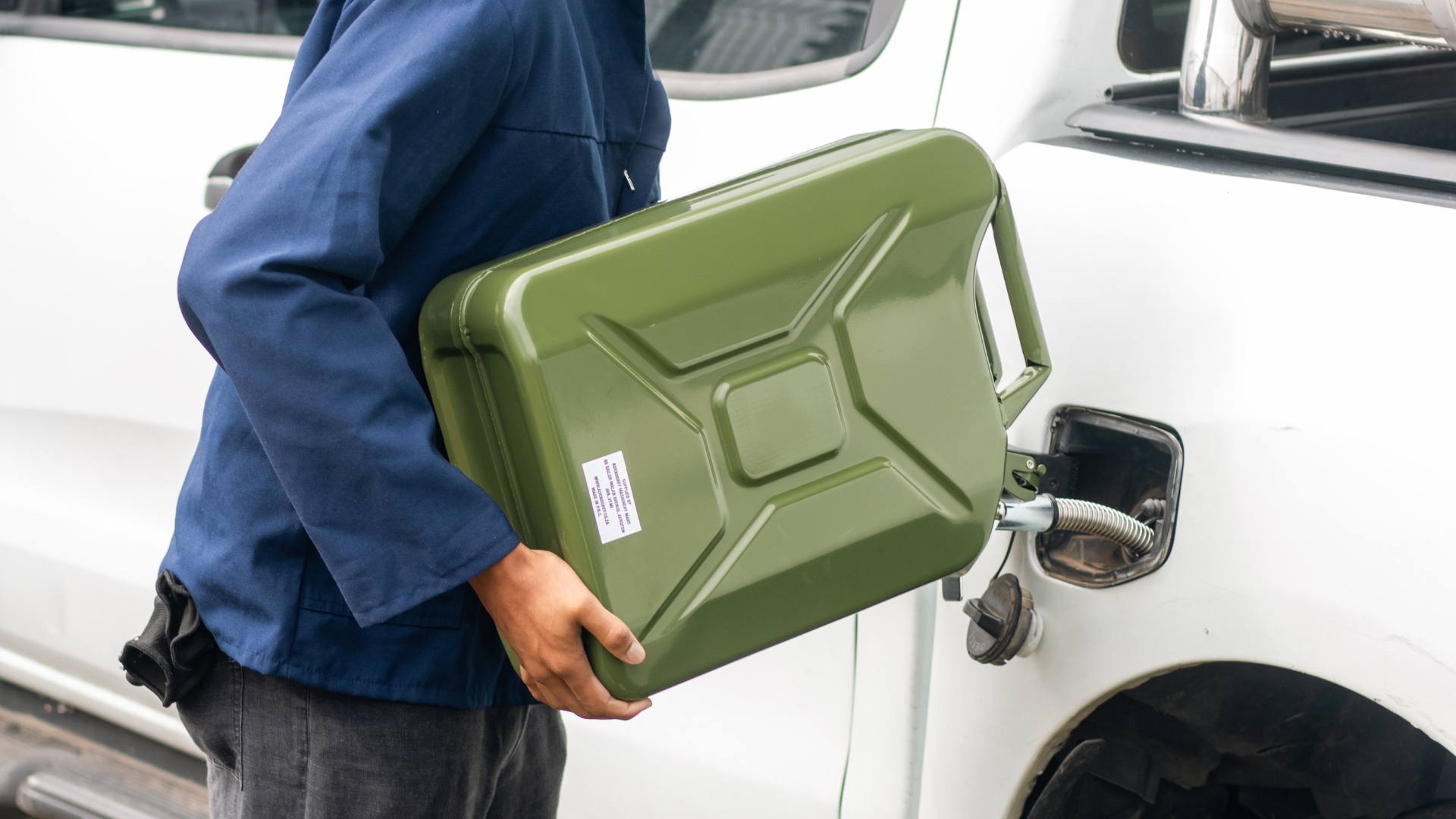
The most popular model in the range, and with good reason. The green finish immediately identifies diesel, while the bayonet-style quick-release nozzle makes filling and pouring faster than traditional screw caps. An internal breather gap prevents the pressure build-up that causes splashing during dispensing. The powder-coated anti-rust exterior and full internal paint coating protect the steel from the mild corrosive properties of diesel over extended storage periods.
Key specs: 20 L • 0.8 mm steel • Bayonet quick-release nozzle • Internal breather gap • Full internal & external paint coating
20L Steel Jerry Can — Red
Built to the same 0.8 mm cold-rolled steel specification as the rest of the range. The red powder coat immediately signals petrol to anyone working in your yard or on your site. The 35 × 45 mm nozzle provides a confident, splash-free pour into vehicle tanks and equipment. Anti-rust powder coat exterior protects against the elements on a bakkie tray or in a site toolbox.
Key specs: 20 L • 0.8 mm cold-rolled steel • 35 × 45 mm nozzle • Anti-rust powder coat
20L Steel Jerry Can — Black
The black variant uses the same cold-rolled steel construction and anti-rust powder coat as the rest of the range, with a 35 × 45 mm cold-rolled steel nozzle. A versatile option for operations that already use a colour coding system, or for secondary diesel containers that are clearly labelled.
Key specs: 20 L • 0.8 mm cold-rolled steel • 35 × 45 mm nozzle • Anti-rust powder coat
20L Steel Jerry Can — Matt Black
The same robust 0.8 mm cold-rolled steel core as the standard black can, finished in a modern matte powder coat for a more refined appearance. A popular choice for overland vehicles, well-presented fleet vehicles, and agricultural operations where equipment presentation reflects professionalism.
Key specs: 20 L • 0.8 mm cold-rolled steel • 35 × 45 mm nozzle • Matt anti-rust powder coat
The Jerry Can Spout Tube:
Pouring from a 20-litre jerry can into a motorcycle, generator, or tight-access fuel filler without spillage is genuinely difficult. The MAC AFRIC Metal Jerry Can Spout Tube (GCANJR000) solves this. The 275 mm rubber nozzle with metal mesh flexes to direct fuel precisely where you want it, with a latch-connection fitting that secures to the jerry can opening without dripping. At 15 mm diameter it fits into narrow filler necks that would cause a standard nozzle to spill. A small investment that prevents a lot of wasted fuel and messy cleanup.
How Many Jerry Cans Do You Actually Need?
A useful rule of thumb: carry or store enough fuel for at least 1.5× your maximum operational need. For a farm generator running 8 hours per day at 3 L/hour, that's 24 litres minimum — so two 20-litre cans gives comfortable headroom. For overlanding, calculate your longest leg between fuel stops, add 30%, and divide by 20 to get the number of cans needed. Always store at least one can as a dedicated emergency reserve and label it clearly.
How to Choose the Right Jerry Can for Your Application
For Farm & Agricultural Use
Choose the green 20L steel can for diesel (tractors, generators, pumps) and the red variant for petrol equipment. The colour coding eliminates misfuelling risk across a team. Buy multiples — having labelled, dedicated cans per fuel type is standard farm practice.
For Fleet Yards & Small Businesses
Steel cans with the quick-release bayonet nozzle (the green model) work well for top-ups and emergency reserves. Pair with a diesel transfer pump for bulk transfers from bulk tanks to vehicles — pouring by hand from jerry cans for fleet refuelling is slow and creates spillage risk.
For Overlanding & Off-Road
The matt black can is a popular choice for roof racks and external mounts on 4x4 vehicles. Steel is essential here — plastic cans can crack from vibration over rough terrain. Add the spout tube for controlled pouring into the vehicle's filler neck.
For Construction & Contracting
Follow the colour convention strictly when multiple fuel types are in use on a site. The black can works well as a general diesel container alongside green cans already in use. Label every can clearly with its contents — especially if non-standard colours are used
For Home / Backup Power
A single 20L green jerry can (diesel) or red can (petrol) is the standard home generator backup. Store in a well-ventilated outbuilding, away from electrical equipment, and rotate fuel every 6–12 months to prevent degradation.
For Emergency Services & Response
Steel cans, properly labelled, meet most emergency service fuel storage requirements. The bayonet quick-release nozzle on the green model speeds refuelling in the field. Always secure cans in purpose-built mounts — never allow them to roll loose in a vehicle.
How To: Choose and Fill a Steel Jerry Can Safely
- Select the correct colour for your fuel type. Green or black for diesel, red for petrol. This is not just convention — it's your first line of defence against misfuelling.
- Inspect the can before every fill. Check for dents, rust spots, and nozzle integrity. A compromised can should not be used for fuel storage.
- Place the can on the ground before filling. Never fill a steel jerry can while it is in the vehicle tray or on a rubber mat. Resting it on the ground allows static charge to dissipate safely — especially critical for petrol.
- Remove the nozzle cap or open the bayonet nozzle before inserting the fuel gun. This prevents pressure build-up inside the can as fuel enters.
- Fill slowly and do not top off. Leave at least 5% headspace (approximately 1 litre in a 20L can) to allow for thermal expansion of the fuel, particularly in hot weather.
- Close the nozzle securely before moving the can. For cans with the spout tube attached, remove the tube, clean the nozzle, and reseal. A leaking nozzle on a moving vehicle is a serious fire hazard.
- Label the can if you use any non-standard colour. A waterproof label stating fuel type and date of fill adds a further safety layer — and helps you track fuel age for long-term storage.
Diesel Transfer Pumps:
There is a limit to how much diesel you can move by hand. Once your daily fuel-handling volume consistently exceeds a few hundred litres, or when you're refuelling multiple vehicles from a bulk storage tank, a diesel transfer pump stops being a luxury and becomes a time-saving, spillage-reducing necessity.
The right pump for your situation depends on three things: your flow rate requirement (how fast you need to move fuel), your power source (12V DC from a battery or 230V AC from mains or a generator), and whether you need metering capability built in or as an add-on.
12V DC vs 230V AC Pumps: Which Do You Need?
12V DC Pumps
- Runs directly from a vehicle battery or leisure battery — no mains required
- Fully portable — take it to the fuel, not the other way around
- Standard crocodile clip or ring terminal connection
- Flow rates from 40 to 80 L/min in the MAC AFRIC and UR-Renson ranges
- Ideal for refuelling from bulk IBC tanks or large diesel drums in the field
230V AC Pumps
- Higher sustained flow rates for high-throughput depot applications
- More powerful motor for continuous-duty pumping
- Typically installed in a fixed bay with overhead hose reels
- Ideal for fleet depots refuelling 10+ vehicles per day
- Requires a weatherproof enclosure if installed outdoors
The MAC AFRIC & UR-Renson Diesel Pump Range
Adendorff stocks a carefully chosen selection of diesel pumps covering the most common field and workshop requirements. Here's a breakdown of each model and where it fits:
MAC AFRIC 12V 40 L/min Diesel Pump Kit
This is the entry-level kit that covers the majority of field applications. The 155W motor draws 13A from a 12V source (a standard vehicle battery connection), delivering 40 L/min at the pump and 60–80 L/min at the nozzle due to nozzle geometry. The kit comes complete — pump, 25mm × 4M hose, and a locking nozzle with half and full pump settings for controlled dispensing. A 1.5M cable connects to the battery. Suitable for diesel only.
Key specs: 155W • 12V • 13A • 40 L/min (pump) • 60–80 L/min (nozzle) • 25mm × 4M hose
MAC AFRIC 12V Diesel Pump with Meter
Identical pump specification to the HPUMPO007 (155W, 13A, 40 L/min pump output) with the critical addition of an integrated flow meter. If you need to record exactly how many litres were dispensed per vehicle or per operator, this is the pump to choose. The same locking nozzle with half/full settings ensures controlled dispensing. Diesel only.
Key specs: 155W • 12V • 13A • 40 L/min (pump) • 60–80 L/min (nozzle) • Integrated flow meter • 25mm × 4M hose
MAC AFRIC 12V 78 L/min Wall-Mount Diesel Pump
Nearly double the pump output of the 40 L/min models at 78 L/min, this unit is designed for permanent installation with a wall-mount bracket. The 350W motor draws 25A (a dedicated battery or battery charger is advisable for sustained use). The automatic nozzle has three locking settings for controlled, hands-free dispensing. At 90–120 L/min nozzle flow rate, this fills a 400-litre bakkie tank in around four minutes — a significant throughput improvement for busy yards.
Key specs: 350W • 12V • 25A • 78 L/min (pump) • 90–120 L/min (nozzle) • Wall-mount bracket • 25mm × 4M hose • 3-setting auto nozzle
UR-Renson 12V 40 L/min Diesel Pump (Pump Only)
The UR-Renson pump-only option at 40 L/min. At 140W and 16A, it's a slightly different motor specification to the MAC AFRIC kit model, with a 2M cable. The pump-only format lets you pair it with your preferred hose diameter and nozzle — useful when integrating into an existing fuel bay setup or replacing a worn pump in an existing installation.
Key specs: 140W • 12V • 16A • 40 L/min • 2M cable • Pump only
UR-Renson 12V 80 L/min Diesel Pump with Meter
The most capable 12V option in the range. At 80 L/min pump output and a 400W motor drawing 50A, this pump is built for serious throughput. It comes with a 4-digit flow meter offering ±0.001 accuracy, max operating pressure of 1.4 BAR, and a 2M hose. The 50A current draw means a direct connection to a robust battery or battery bank is essential — not suitable for a standard vehicle cigar lighter. The integrated meter makes this the complete high-volume metered dispensing solution.
Key specs: 400W • 12V • 50A • 80 L/min (pump) • 76 L/min (nozzle) • Flow meter (±0.001 accuracy) • 2M hose
UR-Renson 230V 110 L/min Diesel Transfer Pump
The highest-flow pump in the range at 110 L/min pump output and 92 L/min at the nozzle. The 0.75 HP / 0.56 kW motor runs on 230V AC at 3A — lower current draw than the high-power 12V models because AC motors are inherently more efficient. Designed for permanent installation in fleet depots, agricultural co-ops, and mining support operations where multiple vehicles need fast refuelling. Pair with the UR-Renson mechanical flow meter for complete dispensing accountability.
Key specs: 0.56 kW • 230V • 3A • 110 L/min (pump) • 92 L/min (nozzle) • 2,800 RPM
Diesel Pump Comparison: Flow Rate
The single most important specification when choosing a diesel pump is flow rate. Too low, and refuelling becomes a bottleneck in your operation. Too high (with the wrong power setup), and the motor draws more current than your supply can sustain. Use this table to match the right pump to your throughput requirement:
| Model | Voltage | Power | Current | Flow (Pump) | Flow (Nozzle) | Meter Included | Best For |
|---|---|---|---|---|---|---|---|
| HPUMPO007 | 12V DC | 155W | 13A | 40 L/min | 60–80 L/min | No (kit) | Field use, farms, small fleets |
| HPUMPO008 | 12V DC | 155W | 13A | 40 L/min | 60–80 L/min | Yes | Fuel accountability, fleet yards |
| HPUMPD011 | 12V DC | 140W | 16A | 40 L/min | — | No (pump only) | Replacements, custom installations |
| HPUMPO080 | 12V DC | 350W | 25A | 78 L/min | 90–120 L/min | No | Wall-mount depot, high throughput |
| HPUMPD080 | 12V DC | 400W | 50A | 80 L/min | 76 L/min | Yes (±0.001) | High-volume metered dispensing |
| HPUMPD110 | 230V AC | 560W | 3A | 110 L/min | 92 L/min | No (add-on) | Fixed depot, high-throughput fleets |
Calculating How Long Your Refuelling Will Take
Divide the tank or container capacity by the nozzle flow rate. A 300-litre IBC transfer using the 40 L/min kit pump takes around 7–8 minutes. The same job with the 78 L/min wall-mount unit takes roughly 3–4 minutes. For a fleet depot refuelling 10 bakkies at 80 litres each (800 litres total), the 110 L/min AC pump completes the job in under 10 minutes of pump time — versus 20+ minutes with a 40 L/min unit. At scale, the investment in a higher-flow pump pays back quickly in labour time saved.
Flow Meters:
A diesel pump without a flow meter is like a till without a receipt printer — everything works, but you have no record of what moved and when. For any operation where fuel costs are a meaningful line item, a flow meter is the essential link between fuel purchased and fuel consumed.
Why Flow Meters Matter: Beyond the Obvious
Theft Prevention
In operations where drivers or operators self-fuel, an unmetered pump relies entirely on honesty and record-keeping diligence. A flow meter creates an objective, numbered record of every litre dispensed — a powerful deterrent and an audit trail if discrepancies arise.
Cost Allocation
Fleet managers, contractors, and farming operations need to allocate fuel costs to specific vehicles, jobs, or cost centres. A flow meter enables this without manual measuring and estimation — dispensed volume is recorded at the point of fuelling.
Inventory Control
Knowing exactly how many litres have been dispensed from a bulk tank allows accurate reconciliation against deliveries — immediately flagging any unexplained losses that might indicate leakage, theft, or pump inaccuracy.
Maintenance Triggers
Many fleet maintenance schedules are fuel-consumption based. A flow meter gives you the accurate data needed to trigger oil changes, filter replacements, and services at the right intervals — not based on guesswork.
The MAC AFRIC & UR-Renson Flow Meters
MAC AFRIC 4-Digit Flow Meter with Coupling
Designed specifically to pair with the HPUMPO007 and HPUMPO008 pump range, this mechanical flow meter installs in-line between the pump and the nozzle. It reads up to 120 L/min with ±0.01 accuracy — sufficient for diesel dispensing where you need to track litres to within a fraction of a litre. The 4-way inlet/outlet configuration (1 inlet, 1 outlet, 1" BSP) gives installation flexibility. Max operating pressure of 3 BAR (50 PSI) is well within the operating range of the 12V pump range. No power required — purely mechanical measurement.
Key specs: 120 L/min max • ±0.01 accuracy • 3 BAR max pressure • 1" BSP inlet/outlet • 4-way usage
UR-Renson 4-Digit Mechanical Diesel Flowmeter
The UR-Renson mechanical meter uses a nutating disk mechanism — a highly accurate and durable metering technology used in commercial fuel dispensing equipment worldwide. It reads up to 120 L/min with exceptional ±0.001 accuracy (ten times more precise than the MAC AFRIC model) and stores both a 4-digit batch total (18mm high display) and an 8-digit cumulative totaliser (6mm display). Max operating pressure is 3.5 BAR (50 PSI), with a 28 BAR (406 PSI) minimum burst pressure for safety. Operating temperature range of -10°C to 60°C covers any South African climate. The 1" BSP connection is standard and compatible with all diesel pump hose and nozzle fittings in the Adendorff range.
Key specs: Nutating disk mechanism • 120 L/min max • ±0.001 accuracy • 4-digit batch + 8-digit totaliser • 3.5 BAR max • 1" BSP
Which Flow Meter Do I Need?
For most small fleet and farming operations running the 40 L/min 12V pump, the MAC AFRIC 4-digit meter provides practical accountability at low cost. If you're running the 110 L/min AC pump in a fleet depot, or if your audit requirements demand higher accuracy (SARS fuel rebate claims, for example), the UR-Renson nutating disk meter with its ±0.001 accuracy is the appropriate choice.
How To: Transfer Diesel Safely Using a 12V Pump
- Position your bulk source and receiving tank on level ground. The pump does not need height advantage — it will draw from below its own level — but level ground prevents the source container from tipping during transfer.
- Connect the pump leads to the battery. Red to positive (+), black to negative (−). For the 40 L/min kit pump, a standard vehicle battery connection with crocodile clips is sufficient. For the 78 L/min unit drawing 25A, use a dedicated battery connection or a battery with a suitable charge state — do not run a high-current pump from a vehicle battery for extended periods with the engine off.
- Submerge the inlet hose or connect it to the tank outlet. Ensure the inlet fitting is secure and does not allow air ingress — air in the inlet line causes cavitation, reduces flow, and can damage the pump impeller.
- Place the nozzle in the receiving tank before starting the pump. Starting the pump with the nozzle in free air wastes fuel and creates a spillage risk. Confirm the nozzle is seated correctly in the receiving tank opening.
- Activate the pump and observe the flow meter reading (if fitted). Use the nozzle locking mechanism to set full or half flow as appropriate — full flow for fast bulk transfer, half flow for topping up to a precise volume.
- Monitor the transfer continuously. Never leave a running pump unattended. Overfilling is the most common cause of fuel spillage during pump transfer.
- Shut off the pump before removing the nozzle. This prevents drips from a pressurised line. Allow a brief pause after pump stop before withdrawing the nozzle from the tank.
- Record the dispensed volume from the flow meter before resetting. For fleet accountability, note the vehicle, operator, and date alongside the litre reading.
- Disconnect the battery leads and store hoses clean and dry. Diesel residue in a warm hose degrades rubber over time — a brief flush with a clean rag before coiling improves hose life significantly.
How To: Install a Flow Meter on a Diesel Pump
- Confirm thread compatibility before purchasing. Both the MAC AFRIC and UR-Renson meters use 1" BSP (British Standard Pipe) fittings — the standard for diesel pump hose fittings. If your existing hose uses a different thread, obtain the appropriate adaptor before installation.
- Install in-line on the outlet (discharge) side of the pump. Flow meters must be installed after the pump — on the high-pressure side between the pump outlet and the dispensing nozzle. Installing on the inlet (suction) side will damage the meter and give inaccurate readings.
- Wrap all thread connections with PTFE tape. Apply 3–4 wraps of PTFE plumber's tape clockwise around the male thread before assembly. This prevents diesel seepage at the fittings without damaging the thread or the meter body.
- Ensure the flow direction arrow on the meter body matches your flow direction. Both meters have a flow direction arrow cast or stamped into the body. Installing in the wrong direction reverses the nutating disk and will produce incorrect readings.
- Tighten fittings firmly — but do not overtighten. Finger-tight plus one-quarter turn with a spanner is usually sufficient for PTFE-sealed BSP fittings. Overtightening can crack meter bodies, which are typically brass or aluminium.
- Prime and test before operational use. Run the pump briefly and check for leaks at all connections. Confirm the meter reads and counts correctly by measuring the dispensed volume against a known-capacity container.
- Record the installation date and starting totaliser reading. This gives you an accurate baseline for long-term fuel accounting — and allows you to spot measurement drift over time if the meter requires calibration.
Fuel Storage Safety & Regulations in South Africa
Diesel is a Category C flammable liquid it has a relatively high flash point (above 55°C) compared to petrol, which means it does not ignite as easily at ambient temperature. However, this leads many users to underestimate diesel's fire and environmental risk. Petrol, by contrast, is a Category A flammable liquid with a flash point below 23°C and vapours that can ignite at normal temperatures. Both fuels require proper storage practices.
Legal Requirements at a Glance
Key South African Fuel Storage Regulations
Fuel storage in South Africa is primarily governed by the Occupational Health and Safety Act (OHSA), the National Environmental Management Act (NEMA), and local authority by-laws. Specific provisions include the General Safety Regulations and the Environmental Regulations for Workplaces. The SANS 10086 standard covers the installation of above-ground flammable liquid storage tanks. For quantities above certain thresholds, your local fire authority may require notification or a fire safety certificate. Always consult your municipal fire department or an accredited safety consultant for your specific installation.
General Fuel Storage Best Practices
- Store fuel in approved containers — steel jerry cans for quantities up to 200L, SANS-compliant portable tanks for larger volumes
- Keep fuel storage areas well-ventilated — fuel vapours are heavier than air and accumulate at floor level
- Maintain a minimum separation distance of 3 metres between fuel storage and any ignition source (electrical panels, welding areas, open flames)
- Post "No Smoking" and "Flammable Liquid" signage in any fuel storage area — required under OHSA
- Keep a suitable fire extinguisher within reach of the fuel storage area (Class B — foam or dry powder for flammable liquid fires)
- Store jerry cans upright and in a stable rack or secured container — prevent toppling that can crack nozzles and cause leakage
- Never store fuel in close proximity to drains or watercourses — fuel spillage into stormwater systems carries significant environmental and legal liability under NEMA
- Bond metallic containers together (earthing/bonding) when transferring petrol to eliminate static build-up between containers
- Inspect containers monthly for corrosion, nozzle integrity, and label legibility
- Maintain a fuel dispensing log — records of quantities dispensed, dates, and vehicle/equipment served create an audit trail required for SARS fuel rebate claims and operational accountability
Diesel Contamination: A Hidden Risk
Water contamination is the most common diesel quality problem in South Africa, particularly during the rainy season. Water enters jerry cans through condensation (temperature cycling) and through improperly sealed nozzles in humid conditions. Even small amounts of water in diesel promote microbial growth ("diesel bug") that blocks fuel filters and damages fuel injection systems. Always store jerry cans with nozzles tightly sealed, drain water from the bottom of bulk storage tanks regularly, and use a fuel filter/water separator in your pump line.
Maintenance & Long-Term Fuel Storage
How Long Does Diesel or Petrol Last in a Jerry Can?
Diesel stored in a clean, sealed steel jerry can typically remains usable for 6–12 months without additives. After this, oxidation and microbial growth can degrade fuel quality, causing filter blockages and reduced engine performance. Petrol has a shorter shelf life of 3–6 months before it begins to degrade, particularly losing its volatility. In either case, adding a commercially available fuel stabiliser at the time of storage extends life to 12–24 months for diesel and up to 12 months for petrol. Always label stored fuel with the date of fill.
Jerry Can Maintenance Checklist
| Task | Frequency | Notes |
|---|---|---|
| Inspect nozzle seal and closure for leaks | Before every fill | Replace nozzle seals if they show cracking or distortion |
| Check exterior for rust, dents, and coating damage | Monthly | Touch up powder coat chips with cold galv spray to prevent rust progression |
| Rinse interior if changing fuel type | When switching fuels | Never use a petrol can for diesel or vice versa without a thorough flush — residual fuel from the wrong type can contaminate and damage engines |
| Verify label integrity | Monthly | Replace faded or damaged fuel-type labels immediately — unlabelled containers are a misfuelling risk |
| Rotate stored fuel | Every 6 months (diesel) / 3 months (petrol) | Use stored fuel in equipment and refill with fresh fuel to prevent degradation |
| Check storage rack/mount integrity | Monthly | Ensure vehicle-mounted can brackets are secure — vibration loosens fittings over time |
Diesel Pump Maintenance
- Flush the pump and hose with a small volume of clean diesel after each session — this removes particulates that accumulate at low points in the hose
- Check cable and connector condition monthly on 12V pumps — corroded battery terminals increase resistance and reduce pump performance
- Inspect the inlet strainer filter (if fitted) every 3 months and clean or replace if blocked — a restricted inlet is the most common cause of reduced pump output
- Store hoses coiled and dry when not in use — hoses left lying flat in the sun degrade faster at the bend points
- Test the flow meter accuracy annually against a measured container — if a 10-litre calibrated container shows significantly more or less than 10 litres on the meter, the meter may need replacement
- Replace hose clamps and fittings at the first sign of seepage — diesel at fittings indicates a seal failure that will progress
Ready to Set Up Your Fuel Storage System?
From colour-coded steel jerry cans to high-flow diesel pumps and precision flow meters, Adendorff has everything you need to store and dispense fuel safely and efficiently.
Frequently Asked Questions
Jerry Cans
How much fuel can I legally carry in my vehicle in South Africa?
The National Road Traffic Act does not set a specific maximum volume for fuel carried in approved containers, but practically, the limit is determined by what you can safely and securely transport. For private vehicles, two to four 20-litre steel jerry cans (40–80 litres) is a common and generally accepted quantity for off-road and farm use. Commercial vehicles transporting fuel as a commodity are subject to the Dangerous Goods regulations under SANS 10228 and require appropriate vehicle licensing and manifesting. For any quantity above 250 litres in a non-tanker vehicle, consult your local traffic authority. Always ensure cans are secured against movement and the vehicle is well-ventilated.
Can I use the same jerry can for both diesel and petrol?
You can, but you really shouldn't — and if you do, a thorough rinse with the target fuel is mandatory before use. Petrol in a diesel engine causes misfiring, white smoke, and potential injector damage. Diesel in a petrol engine (more common because the diesel nozzle doesn't fit a petrol filler — but possible with a jerry can) causes spark plug fouling and requires a full fuel system flush. The far simpler solution is to use dedicated colour-coded cans — green for diesel, red for petrol — and never cross-contaminate them. Engine repairs following misfuelling cost many times more than a second jerry can.
Why is my jerry can nozzle dripping after I close it?
The most likely cause is a worn or deformed nozzle seal. On the bayonet quick-release nozzle (used on the green steel can), the rubber O-ring between the nozzle body and the can opening compresses with use. If the O-ring is cracked, hardened, or out-of-round, it won't seal properly. Replace the O-ring — they are standard sizes available from plumbing and hardware suppliers. On standard screw-cap nozzles, the plastic insert seal degrades similarly. A spout tube with a fresh latch seal can also resolve dripping during dispensing by providing a controlled pour path.
How should I dispose of an old or damaged steel jerry can?
Never cut, weld, or grind an old jerry can without confirming it is completely clean and free of fuel vapour — residual vapour in a "empty" can can cause an explosion with a spark. To prepare for disposal: rinse the interior thoroughly three times with water, leave the cap off and allow it to air out for at least 24 hours in a well-ventilated area, then take it to a scrap metal recycler. Steel jerry cans are fully recyclable. Do not dispose of fuel-contaminated cans in general waste — check with your local municipality for hazardous waste collection options.
Diesel Pumps
Can I use a diesel pump for petrol?
No — and this is important. The pump seals and internal components in the MAC AFRIC and UR-Renson 12V diesel pumps are specified for diesel only. Petrol is a more aggressive solvent than diesel and will degrade the pump's seals, leading to failure and potentially creating a fire hazard (petrol fumes + electrical motor = serious risk). Never use a diesel pump with petrol. If you need to transfer petrol, use a pump explicitly rated for petrol or flammable liquids — these use explosion-proof motor specifications that standard diesel pumps do not meet.
My 12V diesel pump has weak flow — what should I check first?
Work through this sequence: first, check the battery charge — a low or partially discharged battery provides insufficient voltage and the pump will underperform. Second, inspect the inlet hose for kinks, blockages, or loose fittings that allow air ingress — air in the suction line drastically reduces pump output. Third, clean the inlet strainer if one is fitted. Fourth, check the nozzle — a partially blocked nozzle restricts flow at the outlet. If all of these check out and flow is still weak, the pump motor may be worn or the impeller damaged, particularly if the pump has been run dry or on contaminated fuel.
Can I run my 12V pump continuously without damaging it?
Like most 12V DC pump motors, the units in the MAC AFRIC and UR-Renson range are designed for intermittent use rather than truly continuous duty. For sustained high-volume transfers (say, filling a 2,000-litre tank), allow the pump to cool for 5–10 minutes after every 20–30 minutes of operation. Running beyond this without breaks causes heat buildup in the motor windings that accelerates insulation degradation. For genuinely continuous high-volume duty, the 230V AC pump with its more robust motor is the better choice.
Flow Meters
Do I need a flow meter if I'm only refuelling one or two vehicles?
It depends on whether fuel cost accountability matters to you. For a private individual or sole trader with a single vehicle, a flow meter is optional — you can track fuel use through purchase receipts. But for any operation where multiple people have access to the fuel supply, where costs need to be allocated to jobs or vehicles, or where you want to detect consumption anomalies early, a flow meter pays for itself quickly. The MAC AFRIC 4-digit meter is an affordable entry point — the cost of even one undetected fuel theft event typically exceeds the price of the meter many times over.
How accurate are mechanical flow meters, and do they drift over time?
The UR-Renson nutating disk meter is rated at ±0.001 accuracy — meaning it will measure within 0.1% of the true dispensed volume under normal conditions. Mechanical meters can drift slightly over very long service lives as the nutating disk and chamber surfaces experience wear. Annual calibration checks against a known-volume container are good practice. If the meter consistently reads more or less than the physical measurement, the nutating disk mechanism may need cleaning (diesel contaminants can accumulate) or the meter may need replacement — they are not typically serviceable in the field.
Where to Buy Fuel Storage Equipment in South Africa
Adendorff Machinery Mart operates 29 branches across South Africa — from Cape Town to Polokwane, Durban to Kimberley — with nationwide delivery available from the Aeroton, Johannesburg distribution centre. Whether you're a farmer in the Free State, a fleet manager in Gauteng, or a contractor in the Western Cape, there's a branch within reach or a delivery to your door.
Shop Online or Visit In-Store
Browse the full range of jerry cans, diesel pumps, and flow meters at adendorff.co.za and place your order online for nationwide delivery. Alternatively, visit one of 29 branches for hands-on advice from knowledgeable staff. Use the online store locator for directions and trading hours.
| Branch | Province | Phone |
|---|---|---|
| Johannesburg Aeroton (Head Office) | Gauteng | 011 434 7000 |
| Johannesburg Springfield | Gauteng | 011 434 7152 |
| Edenvale | Gauteng | 011 454 1407 |
| Randburg (Strydompark) | Gauteng | — |
| Roodepoort / Krugersdorp | Gauteng | 011 664 8336 |
| Boksburg | Gauteng | 011 914 1550 |
| Springs | Gauteng | 010 442 6969 |
| Pretoria (Gezina) | Gauteng | 012 329 9576 |
| Pretoria East (Silver Lakes) | Gauteng | 012 054 5969 |
| Centurion | Gauteng | 012 653 0586 |
| Vereeniging | Gauteng | 016 422 6057 |
| Cape Town (Montague Gardens) | Western Cape | 021 552 7389 |
| Cape Town (Brackenfell) | Western Cape | 021 205 7888 |
| Strand | Western Cape | 021 205 7878 |
| George | Western Cape | 044 050 3610 |
| Durban (Umgeni Business Park) | KwaZulu-Natal | — |
| Durban (Umbilo) | KwaZulu-Natal | 031 202 4355 |
| Pietermaritzburg | KwaZulu-Natal | 033 345 1996 |
| Port Elizabeth (Gqeberha) | Eastern Cape | — |
| Bloemfontein | Free State | 051 448 1689 |
| Welkom | Free State | 057 355 6600 |
| Klerksdorp | North West | 018 462 1116 |
| Rustenburg | North West | 014 594 1545 |
| Polokwane | Limpopo | 015 292 0243 |
| Louis Trichardt ⭐ Coming Soon | Limpopo | — |
| Nelspruit (Mbombela) | Mpumalanga | 013 753 3580 |
| Witbank (eMalahleni) | Mpumalanga | 013 690 2305 |
| Kimberley | Northern Cape | 053 831 1882 |
Check Stock Before You Travel
Jerry cans, diesel pumps, and flow meters are high-demand items — call ahead or check online at adendorff.co.za to confirm stock availability at your nearest branch before making the trip. The team can also advise on transfer times from the warehouse if a specific model isn't immediately available in-store.