Adendorff Ladder Induction Training Guide
Adendorff Ladder Induction Training Guide
This guide is designed to help sales staff and customers identify the correct ladder for any job. Two key steps are required: first, select the correct ladder by type based on the customer's needs; then determine the correct ladder for the application — including height, load rating, and environment.
Table of Contents
Step 1 – Selection of the Correct Ladder by Type
You need to know what your customers require the ladder for to identify the correct type. Adendorff stocks the following ladder categories:
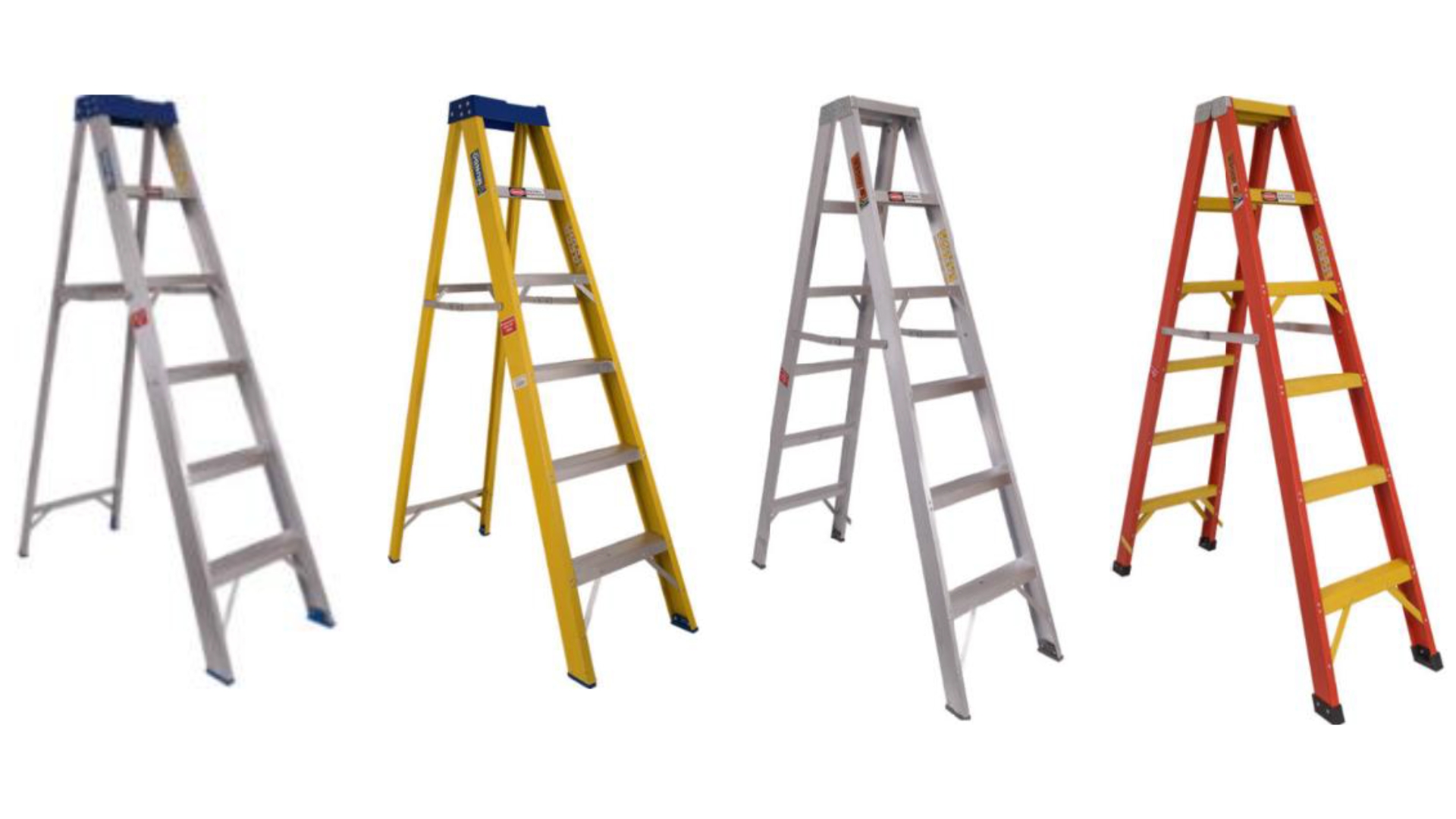
Step Ladders (Single & Double Sided)
Aluminium Single Sided Medium A-Frame Ladder
Available in 4, 6 & 8 Step
Partial Fibre Single Sided A-Frame Ladder
Available in 4, 6, 8, 10, 12, 14 & 16 Step
Aluminium Double Sided A-Frame Ladder
Available in 3, 4, 6, 8, 10, 12, 14 & 16 Step
Full Fibre Double-Sided A-Frame Ladder
Available in 4, 6, 8, 10, 12, 14 & 16 Step
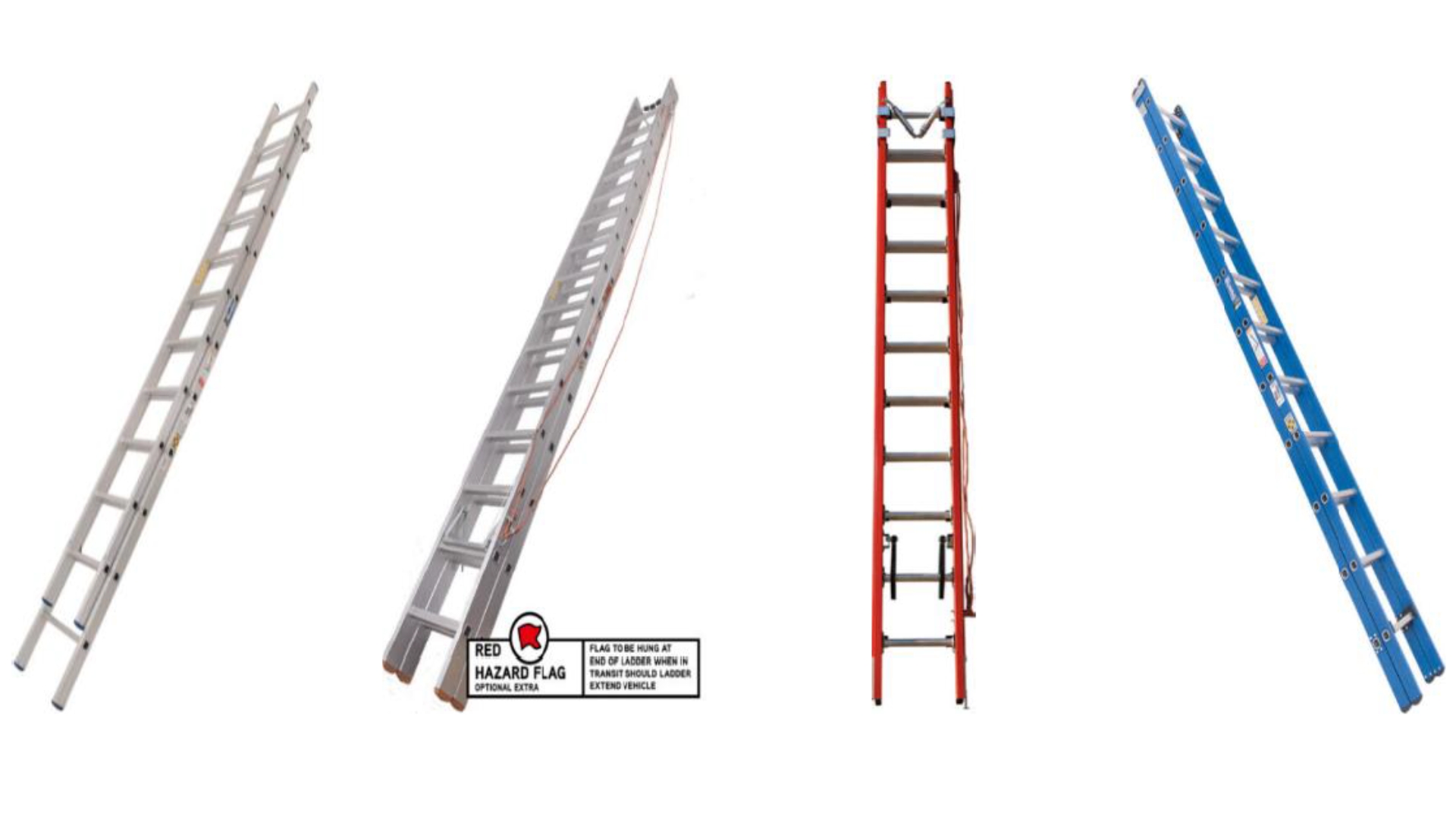
Extension Ladders
Aluminium Extension Ladder
Available in 6m, 7.8m & 9m
Aluminium Heavy Duty Industrial Extension Ladder
Available in 9m, 10.2m, 11.4m, 12m, 12.9m & 14m
Badger Fibreglass Extension Ladder
Available in 5.7m, 6.3m, 7.6m, 8.7m, 9.6m, 11.1m & 12.3m
Telkom Fibre Extension Ladder
Available in 6m, 7.6m & 9m
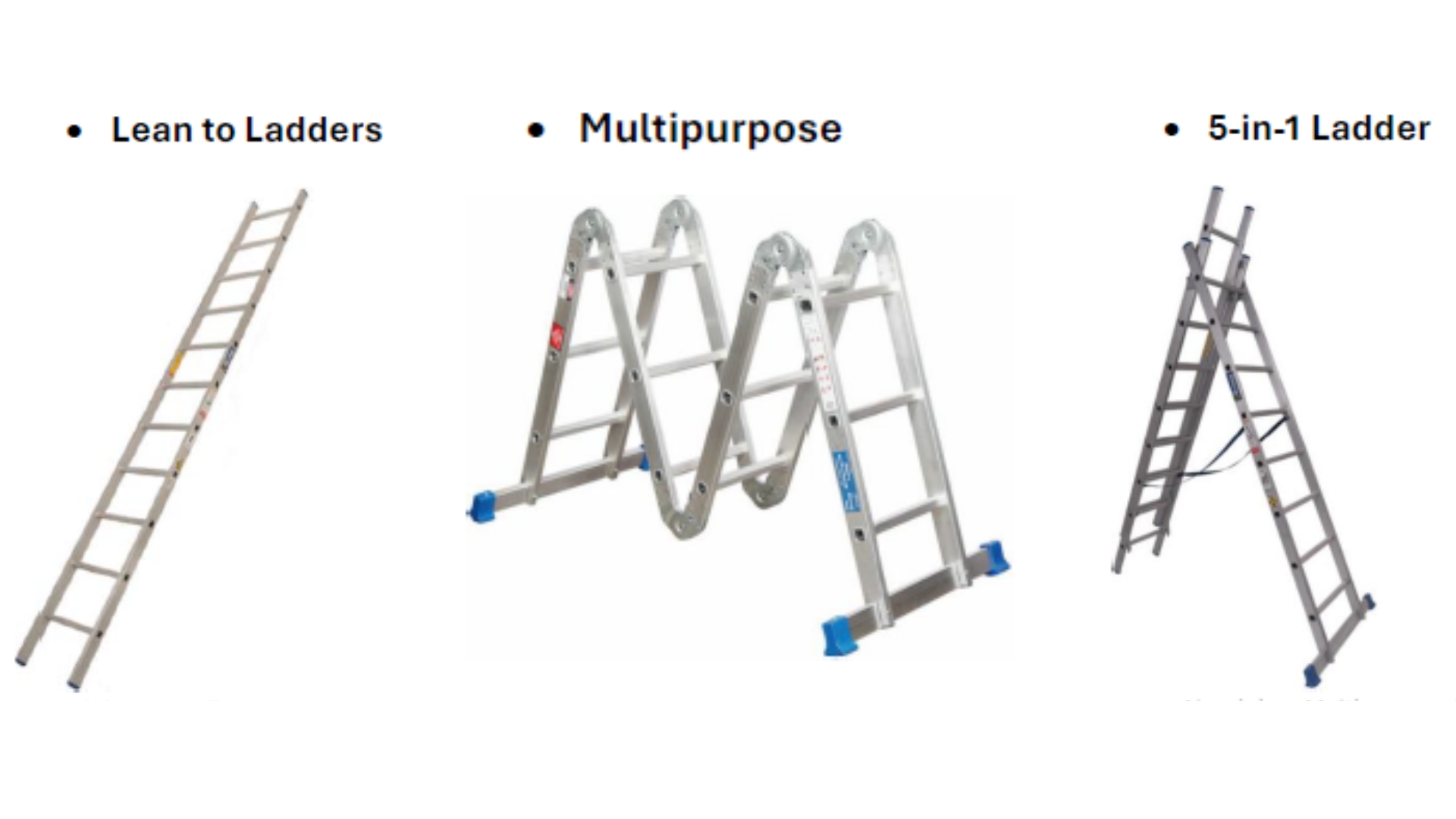
Lean to Ladders
Aluminium Lean To Ladder
Available in 2.4m, 3.4m, 4.9m & 6m
Multipurpose Ladders
Aluminium Multipurpose Ladder
Available in 3.5m
Aluminium Multipurpose 5-in-1 Ladder
Available in 5.2m
Step 2 – Choosing the Right Ladder for the Job
Load Rating: Medium-Duty vs Heavy-Duty
Medium-Duty (Non-Professional)
Designed for occasional use. Maximum static vertical load rating of 150 kg. Dynamic safe workload: 113 kg.
Heavy-Duty (Professional)
Designed for daily commercial use. Maximum static vertical load rating of 170 kg. Dynamic safe workload: 136 kg.
Static vs Dynamic Load — What's the Difference?
Static loading involves weight that remains constant and does not experience any external forces during rest. Dynamic loading involves weight that is in motion and subject to additional forces during movement — this reduces the safe working load. Always consider the dynamic load when selecting a ladder.
Ladder Selection Checklist
- Select a ladder of proper length to reach the working height.
- The ladder is designed to support the weight of one person plus materials and tools — not more than the working load shown on the notice sign.
- Select the correct duty rating: Heavy (170 kg), Medium (150 kg), or Domestic (100 kg).
Note on Domestic Ladders
Domestic ladders rated at 100 kg are not catered for in SANS 50131:2017 and should not be used in a professional or commercial work environment.
Legal Requirements
The Occupational Health and Safety Act, 1993 (Act No. 85 of 1993) — General Safety Regulations, Section GSR 13A, sets out the following requirements for ladders in the workplace:
Construction & Stability
- Every ladder must be constructed of sound material and suitable for the purpose for which it is used.
- Ladders must be fitted with non-skid devices at the bottom and hooks or similar devices at the upper ends, OR must be lashed, held or secured to ensure stability at all times.
Prohibited Ladder Conditions
No employer may use — or permit the use of — a ladder that:
- Has rungs fastened to stiles only by nails, screws, spikes or similar, or rungs not properly let into the stiles.
- Has damaged stiles, or damaged or missing rungs.
Length Restrictions
- A ladder required to lean against an object for support may not be longer than 9 m.
- Two or more ladders may not be joined to extend reach without inspector approval (this does not apply to free-standing extension ladders).
Wooden Ladders
- Must be constructed of straight-grained wood, free from defects, with grain running the length of stiles and rungs.
- Must not be painted or covered unless confirmed to have no cracks or inherent weaknesses — ladders may be treated with oil, clear varnish, or wood preservative.
Working from a Ladder
- Take special precautionary measures to prevent articles from falling off.
- Provide suitable sheaths or receptacles in which hand tools shall be kept when not in use.
Fixed Ladders Exceeding 5m
A fixed ladder exceeding 5m in length attached to a vertical structure at an inclination of 75° or more must:
- Have rungs at least 150 mm away from the structure.
- Be provided with a cage extending from no more than 2.5m above the lower level to at least 900 mm above the top level served.
- The cage must afford firm back support, with no part more than 700 mm away from the level of the rungs.
⚠ Important Note
Portable ladders do not offer any protection from a fall.
Inspection
Every ladder must be inspected upon receipt and before each use. Never climb a damaged, bent or broken ladder.
- All parts must be in good working order.
- All rivets, joints, nuts and bolts are tight; steps, spreaders and braces are secure; spreaders and pail shelf (if fitted) function properly.
- Keep the ladder free from grease, oil, mud, snow, wet paint and other slippery materials. Keep shoes clean — leather soles should not be used.
- Never make temporary repairs to damaged or missing parts.
- Destroy the ladder if broken, worn, or if exposed to fire or chemical corrosion.
Maintenance Reminder
Check the condition of your ladder before ascending. Do not climb broken ladders. Store in a safe and dry area.
Proper Setup
⚡ DANGER — METAL CONDUCTS ELECTRICITY!
Do not let ladders of any material come in contact with live electrical wires.
- Make sure the ladder is fully open, the spreaders are secure, and the pail shelf (if fitted) is in position. The multipurpose ladder hinge must be in the locked position.
- Place on a firm, level surface with a secure footing.
- Do not use on a slippery surface.
- Do not place on boxes, unstable bases or scaffolding for additional height.
- Do not place in front of a door or window opening toward the ladder.
Correct Setup for a Straight/Extension Ladder
- At least 0.9m overhang above the access point.
- Secured at the top.
- Hoist tools and equipment in a bucket when at the top — keep both hands on the rails when climbing.
- Always face the ladder when ascending or descending.
- Before climbing, test stability by jumping on the bottom rung.
- The ladder must be secured, and maintain a 4:1 height-to-width ratio (75° angle).
- The foot of the ladder must be a minimum of 1m from the "upper-support" point.
Proper Climbing and Use
- Never use a ladder when under the influence of alcohol, drugs or medication, or in ill health.
- To protect children, do not leave a ladder set up and unattended.
- Always face the ladder when climbing up or down.
- Keep your body centred between the side rails.
- Use both hands while climbing; one hand while working.
- Never climb a ladder from the side unless it is secured against sideways motion.
- Do not over-reach — move the ladder when needed.
- Do not walk or shift the ladder while on it.
- Do not stand, climb or sit on braces, spreaders, pail shelf, or the back section on or above the second step from the top of the ladder.
- Ladders are meant for one person only. Do not use as a brace, platform or plank.
- Keep the ladder close to work — avoid pushing or pulling the side of the ladder.
✅ The Right Way
- Right height for the job — no overreaching
- Good grip — 3 points of contact
- Facing front towards work
- Correct footwear
- Steps in good condition, clean treads
- Four ladder feet in good condition
- Firm and level base
❌ The Wrong Way
- Overhead hazard
- Wrong height — overreaching
- No grip on step — only 2 points of contact
- Standing on the top handrail
- Incorrect footwear
- Loose tools
- Working side-on
- Slippery treads
- Uneven, soft ground — no flat board
- Damaged stiles/side rails and tread
- Missing feet
Proper Care and Storage
- Store ladder in a safe and dry place.
- Properly secure and support the ladder while in transit.
- Never store material on a ladder.
- Keep the ladder clean and free of all foreign material.
Ladder Information — Choose the Correct Stepladder
Use the table below to match the required reach height to the correct stepladder size. Assumes a person's height of 1.7m.
| Reach Height | Steps | Ladder Working Height | Open "A" Height |
|---|---|---|---|
| 2.30m | 4 Step | 0.60m | 1.20m |
| 2.90m | 6 Step | 1.20m | 1.80m |
| 3.50m | 8 Step | 1.80m | 2.40m |
| 4.10m | 10 Step | 2.40m | 3.00m |
| 4.70m | 12 Step | 3.00m | 3.60m |
| 5.30m | 14 Step | 3.60m | 4.20m |
| 5.90m | 16 Step | 4.20m | 4.80m |
Average Building Heights for Reference
One Storey Home: Eaves at approximately 3.35m; ridge at approximately 5.18m.
Two Storey Home: Eaves at approximately 5.79m; ridge at approximately 7.62m.
Ladder Information — Choose the Correct Extension Ladder
Use the table below based on the height to the gutter or top support point. Reflects section overlap, ladder angle and 1m extension above the roof line.
| Height to Gutter or Top Support Point | Size Extension Ladder to Buy |
|---|---|
| 1.4m – 2.9m | 4.80m |
| 2.0m – 4.1m | 6.00m |
| 2.6m – 5.2m | 7.20m |
| 3.2m – 6.4m | 8.50m |
| 3.8m – 7.6m | 9.70m |
| 4.2m – 8.5m | 11.0m |
| 4.8m – 9.3m | 12.10m |
| 5.5m – 10.5m | 13.40m |
Need Help Choosing a Ladder?
Contact the Adendorff team for expert advice on the right ladder for your job.
011 434 7000 | ✉ [email protected] | www.adendorff.co.za
Supplied by:
Adendorff Machinery Mart
98 Sailor Malan Avenue, Aeroton, Johannesburg, 2190
www.adendorff.co.za